Wednesday, March 16, 2011

Book Review: The Rite

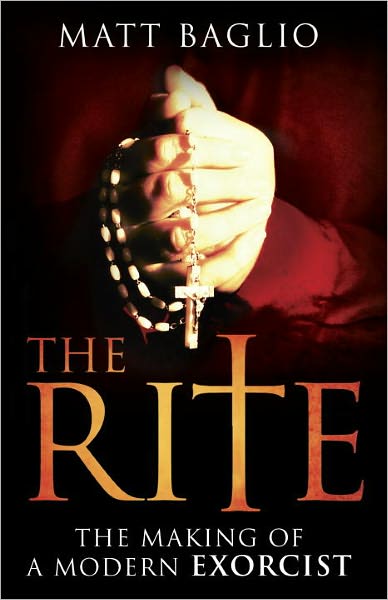
The Rite (2010 paperback) by Matt Baglio is one of the best books I have ever read. I give it 9 out of 10 stars.

This is the book that served as the inspiration for the movie The Rite (2011) starring Anthony Hopkins, which I reviewed in January.

Both mediums, particularly the book, pleasantly treat the subject of exorcism as one that requires caution. But the book is much better than the movie. The book is non-fiction and follows the training of San Francisco priest Father Gary Thomas as he journeys to Rome to learn the trade of exorcism (the movie character Michael Kovak is said to be based on a Chicago-area exorcist). We are given in most chapters glimpses into the mind of Father Gary for whom exorcism was mostly an alien enterprise prior to his Roman visit. The reader sees through Father Gary's eyes for the first time truly horrific and unexpected events. Yet there is always a balance of humility and a desire for prudence in this learning priest's disposition. Due consideration is always given to science in accord with the Church's advice to utilize the examinations of medical doctors. One of the exorcist's primary goals is to discern when a disorder is natural or supernatural.

That brings me to another great quality of this book. There are some tangents from Father Gary's direct experiences. These tangents are typically informative and are useful in understanding the subject matter in general. For instance, on page 204, Baglio finishes a discourse on several scientific studies into potential possessions and human disorders with: "If true, quantum entanglement could help to explain how things like healing from a distance, or the power of prayer, actually work." Baglio's prudential consideration to detail and explanation make me suspect his witnessing of the Church's cautious training on exorcism lead him to the same prudence.

As well, the book is fraught with side comments on exorcism from a other exorcists including Father Gabriel Amorth who is Rome's chief exorcist, and a good number of other exorcists with whom the author had contact. This is a critical part of the value of this book. For those interested in the subject of exorcism, comparing and contrasting the experiences of actual exorcists is invaluable. The reader learns throughout the book that demons often exhibit similar behavior when manifesting. Yet sometimes behaviors are unexpected. This is where the array of experiences among the exorcists is especially useful in developing the Church's knowledge of the subject matter. Just as scientists throughout the world compare and contrast their various results to accelerate the learning process, so too do these appointed exorcists. This book is fantastic for detailing a variety of demonic behaviors.

One one occasion, Baglio describes the disparity of experience by different people present at the same exorcism (page 149): "During the exorcism, Father Gary had the overwhelming sensation that the room was suffocatingly hot, while the priest from Indianapolis smelled a terrible 'over-powering' stench." Were multiple demons at work? Was the same demon attempting to confuse? Was there something about the priests that made them each sensitive to particular phenomenon? It is details such as these that inform students of the subject much of the mystery involved in discernment and liberation and why so much care must be taken.

Contrary to one of the weaknesses of the movie, the book's Father Gary is not a "doubting" figure with a flippant attitude like his parallel film character. Father Gary enters the arena not knowing what to expect. He may ask himself "why," as the reader learns during a description of a near-fatal accident earlier in Father Gary's life, but he does not exhibit the sustained defiance of many shaky priests that are native to some Hollywood productions.

One of the saving grace of the film was echoing some of the book's details of exorcisms. The book The Rite is especially valuable for its first-hand accounts of actual exorcisms. During these scenes, my eyes were glued to the dramatic and detailed accounts of levitation, demonic dialogue, feats of strength and contortion, and other phenomenon that baffle even scientists. Those looking for a window into the actual battle of the experience will not be disappointed. From the first page, the struggles and tactics of demons during an exorcism are detailed.

A humorous moment preserved in the film, perhaps taken from the book, was a priest answering a phone during an exorcism (page 103). In comparing the two works, this parallel detail stood out since it was unusual. The book follows the moment with a description of how the priest immediately returned where he left off and the victim resumed the same disposition she had when she left. This additional information in the book leaves the reader with the feeling that the exorcist was in complete control, whereas in the movie the viewer is left wondering if Anthony Hopkins' character is crazy.

The book The Rite also includes a number of other valuable details. This includes pertinent Scriptural verses, reference resources, and perhaps most valuable to anyone is information on those most at risk for possession. Baglio often refers to the victim's experiences in the occult prior to their admission to exorcism.

Friday, March 11, 2011

Should earthquakes shake faith in God?

First, let me offer sympathy and prayer for those suffering as a result of the recent Japanese earthquake and subsequent tsunami. Their trial is severe, unimaginable, and horrific. I do not want my attempt to address a theological issue here to be incorrectly seen as a selfish insensitivity to that reality.

That being said, I want to Scripturally and philosophically address a reaction that invariably is made by skeptics whenever a tragedy dominates the headlines. And I would like to remind any reader that this is not an exhaustive explanation of death and suffering. There are many resources I would encourage anyone to explore such as Padre Pio's Secrets of a Soul, Dr. Peter Kreeft's Making Sense Out of Suffering, C.S. Lewis' The Problem of Pain, or any of Fr. John Corapi's talks on suffering.

Anyway, I read two skeptical posters at the Catholic.com forums make similar comments today. I remember back in the day watching the South Park movie (not a good example for kids by the way!) hearing the same basic line in the face of disaster: "Where is your God when you need him?"

Along with sympathy for the victims of the tragedy, I do have sympathy for the skeptic's reaction. It is no easy thing for a human being to feel at a loss while simultaneously believing God loves him. Even a faithful Christian might feel unsettled by the innocence afflicted by such a disaster.

The reason I think this reaction is common is because in the human mind, there is often an equation of suffering or death with evil. If God permits an innocent person to suffer, He therefore must not love that person.

I think some strains of Christianity, such as those who espouse a "prosperity gospel" have an inadequate response to tragedy and God's love. However, I think Catholic theology can make sense of such suffering.

First, as apologist Jimmy Akin once wrote on his blog:
[God] gives all of us an infinite amount of [the gift of life] because, once we are created, we will endure forever. After the resurrection, we will all--every one of us--have an infinite amount of physical life ahead of us. What we are discussing, therefore, is whether some of us receive an infinite amount of physical life plus a varying amount of finite physical life as well.
When someone dies to the terrestrial, temporal universe, it is by no means the last word. If the Catholic truth that eternal life awaits those who lived faithfully to the divine movements in their hearts, then no amount of measurable, temporal punishment can possibly compare to an eternal reward. The temporal suffering is obliterated by an eternal life with no suffering.

So why is there suffering at all, even if temporal? Catholics understand suffering to have value for the soul as well as humanity itself. Catholics believe that the path fallen man must take to be reunited with God in eternal joy is through Jesus Christ who opened this door for humanity through his suffering on the cross. Thus, if Jesus Christ was truly God incarnate, and if he willingly permitted himself to endure suffering at the hands of his own creatures, then even if we do not fully understand the scope of suffering, we can see a great testament from divinity himself that there is purpose to suffering.

In Catholicism, we believe suffering is a means to be united with Christ's salvific work on the cross. St. Paul teaches about the salvation of mankind with the included caveat: "provided we suffer with him" (Rom. 8:17). Temporal suffering, as Christ experienced on the cross, is a sequential prerequisite to resurrection into eternal life. That would include even infants who must undergo temporal death despite never having committed "actual sin."

As well, in Catholicism, suffering is seen as a mechanism of cleansing a person of the effects of sin, conforming him to the spotless being he shall be in the next life. This takes place as an extension of the singular sacrifice of Christ (see CCC#1473 and preceding). A non-Catholic who does not believe in the temporal consequence of sin will not recognize the value of suffering in this way.

Not to limit this apologetic to Scripture or even exclusively Catholic theology alone, we can in some way grasp the idea that something once perceived valueless can be of the utmost value. As Dr. Peter Kreeft said in his talk Making Sense Out of Suffering a few years ago, if a baby in the womb could rationalize, he would say to himself, for example, why do I have feet? There are no sidewalks here! While the existence of feet in his current domain appears valueless, the next domain beckons their use and feet are of value.

Another example is one that is used as a Christian figure of God's relationship to mankind (although it is evident to anyone): The father-child relationship. Fathers (or mothers) discipline their children. Sometimes it can come in the form of letting a child touch a sharp weed so that the child will learn the danger of the action. The father could lovingly inflict or permit suffering for a variety of reasons including that the child misbehaved or did something detrimental to himself that the father did not want the child to repeat. The discipline is applied to the child for a) reasons the child does not understand, and b) for reasons that result in the improvement of the child's person. If we look at this example categorically, then we must admit not all infliction or permission of suffering equals evil or lack of love even if the recipient does not recognize value in the pain.

If a skeptic recognizes the love of a parent who permits his child to suffer for that child's betterment, then he must acknowledge God could similarly do the same. God's permission of suffering can rationally have an entirely loving motive behind it.

There's an animated science series featuring a "Dr. Quantum" that covers various topics including quantum physics and spatial dimensions. One of the videos is called "Flatland." In the video, Dr. Quantum exists in 3-dimensions just as any terrestrial human being does. He stands over a "flat" universe in which dwells 2-dimensional "Pac-man-looking" people. The 2-dimensional people understand only length and width. Depth is inconceivable to them. Nothing in their existence can be used to depict depth either. Dr. Quantum dips his finger into the 2-dimensional world. A 2-dimensional character only sees an expanding and shrinking circle as Dr. Quantum's finger passes into and out of the 2-dimensional surface. From her perspective, Dr. Quantum is a circle who varies in size. She cannot conceive of the reality beyond her 2-dimensional perspective.

The analogy can help us understand God's perspective. God as an eternal, extra-terrestrial being has a perspective and understanding of reality beyond that of terrestrial man. He may see more of suffering than we see.

In summary, if this world is not the final say, it is specious to measure the value of any divine action or permission based on man's temporal reaction. It is specious even for a skeptic to conclude that if suffering and death occur that God must therefore not love or perhaps not even exist. There are enough signposts in the terrestrial domain that show how suffering can have value.

Saturday, March 5, 2011

Papacy debate

In 2008, I did a public formal debate online at Christian Forums on the papacy. The topic was Rome's universal authority was known for all ages. My portions of the debate are posted under the username MrPolo. Here is a link to that debate. Enjoy!

Related post: See the Particular Atonement debate here.

Saturday, February 26, 2011

Debunking the doctrine of "Limited Atonement"

Below is a PDF of a 20-page paper for my Pauline Soteriology class defending the idea that Christ's sacrifice was intended for all humanity and not just some as the doctrine of Limited Atonement asserts.

Click here to download The Universality of Salvation.
(I improved a few grammatical parts in this PDF from when it was first submitted. Also, this is a much more extensive treatment on the subject than my Jan. 9 article on the Scope of Christ's sacrifice.)

Thursday, February 3, 2011

Sacrawhat? Misconceptions about Sacraments

On the morning of Tuesday, February 1, 2011, I heard Pastor John MacArthur (whose misconceptions about Catholicism I have previously addressed) state the following during his radio-aired sermon titled "The Responsibilities of the Church: Preaching":
As you look back over the history of the Church, look back over the epochs that have thrown themselves as it were against the Church, a number of things come to mind immediately. First of all, let's start with the dangerous epochs at the time when Christianity became the religion of the Holy Roman Empire. So you have not long after that what is commonly known as the Dark Ages that runs from the time of the establishment of the Holy Roman Empire clear through to 1500. Over 1000 years of Dark Ages they're called. And the dominating danger to the Church at that time was sacramentalism. Sacramentalism. And that's the word that you will identify in your mind with this first epoch. Sacramentalism means that the Church was dominated by sacraments, by mechanisms, by external mechanical means--dominated by attempting to know God through some kind of automatic action. Whether it was lighting a candle or genuflecting or it was bowing down, whether it was going through beads, or whether it was inflicting some pain upon yourself physically, whatever it might have been, these were mechanical means supposedly to give people salvation. Sacramentalism was a severe danger to the Church. ... You attached yourself to the Church externally. ... [S]acramentalism came and stayed, and it's still with us.
There are several misconceptions in this discourse. And although MacArthur never uses the word "Catholic" in this particular sermon, he has argued against sacraments in Catholicism elsewhere in nearly identical language.1

Misconception #1: Sacraments are "external means" that involve "automatic action" involving only "external" attachment to the Church.

MacArthur believes sacraments involve only external actions that have some "automatic" result. This is not the case. All seven sacraments in the Catholic Church are signal of interior realities as well.

Consider the Catholic concept of how Jesus Incarnate was sacramental according to the Catechism of the Catholic Church:
CCC#515 His humanity appeared as "sacrament", that is, the sign and instrument, of his divinity and of the salvation he brings: what was visible in his earthly life leads to the invisible mystery of his divine sonship and redemptive mission.
Notice the terms describing sacrament: sign, instrument, visible, invisible. Just as Christ's physical death lead to the outpouring of grace, so too do His sacraments. Look how the Church views the sacrament of marriage:
CCC#1617 Christian marriage in its turn becomes an efficacious sign, the sacrament of the covenant of Christ and the Church.
The point in quoting these two paragraphs is to show that the definition of a sacrament goes beyond the external. Remember, MacArthur argued that Catholics believe the way to attach to the Church is simply externally. But Catholics do not believe this. It is possible MacArthur is unaware of what a sacrament is. Openness to Christ is mandatory for the sacraments to have effect. They are not merely mechanical as MacArthur asserted that Catholics believe.
If any one saith, that the sacraments of the New Law do not contain the grace which they signify; or, that they do not confer that grace on those who do not place an obstacle thereunto...let him be anathema. (Council of Trent, 7.VI)

The sacraments always give grace if we receive them with the right dispositions. Therefore whoever eats this bread or drinks the cup of the Lord unworthily, will be guilty of the body and the blood of the Lord. (I Corinthians 11:27) (Baltimore Catechism #309)
He who knowingly receives a sacrament of the living in mortal sin commits a mortal sin of sacrilege, because he treats a sacred thing with grave irreverence. (Baltimore Catechism #312)
To receive the salvific remedy of the sacrament of penance, a member of the Christian faithful must be disposed in such a way that, rejecting sins committed and having a purpose of amendment, the person is turned back to God. (Code of Canon Law, #987)
You see the sacraments are not "automatic" as MacArthur claimed Catholics believe. According to Catholic teaching, a skeptic who received the waters of baptism would not receive the graces bestowed in baptism because he posited an obstacle. The recipient resisted what the sacrament conferred. Necessarily, interior conversion must accompany the recipient,2 whether it be during baptism, confession, reception of the Eucharist, etc...

There are a number of Catholic resources that defend the reality that sacraments really confer grace. A few examples from Scripture include the teaching that in baptism we die and rise with Christ (Rom. 6:4), are saved by baptism (1 Pet. 3:21), and that baptism results in the forgiveness of our sins (Acts 3:28). Partakers in the Eucharist are given life (John 6:47-68), and participate in Christ's sacrifice as well as commune with other members of the Church (1 Cor. 10:16-17). Etc... Sacraments are not substitutes for salvation by Christ. They are rather instruments established by Christ for us to receive His grace. No one can truthfully say Catholics believe salvation is through sacraments instead of Christ.

Christ Himself juxtaposed outward signs with inward realities so that we would believe in that which we could not see. The story of the paralytic is an example of this. Jesus healed the paralytic and asked the crowd, "Which is easier, to say stand up and rise or that your sins are forgiven"? (Luke 5:17-26). What Jesus was demonstrating, is that what He showed visibly was the same thing that happened spiritually. The onlookers therefore were prompted to have faith in what they could not see (that the man's sins were healed) because of what they could see with their eyes (that the man was physically healed). So too, the sacraments bear a visible and invisible character,3 not just something external as MacArthur incorrectly understands.

Misconception #2: Sacraments came to the Church only after "Christianity became the religion of the Holy Roman Empire."

It is unclear when precisely MacArthur believes this to have taken place. He does state that by 1500, sacraments had been in the Church for "over 1,000 years." That places the beginning at least prior to 500. For the purpose of this post, I am going to give all benefit of the doubt to MacArthur and say he believes sacraments began in 311/313 with the Edict of Tolerance and Edict of Milan by Roman emperors Galerius and Constantine. Although these imperial decrees did not yet make Christianity the official religion of the state, they did make Christianity legal to practice. (It is often said the Edict of Thessalonica in 380 was the beginning of Christianity as the official state religion of Rome).

So going with the earliest date of 311, we take a look earlier to see if what MacArthur suggested was true. Did the Church only become sacramental after 311? For learned Catholics, the answer seems obvious: of course not. To those unfamiliar with the writings of the earliest Christians, the following may prove enlightening.
A.D. 75
Epistle of Barnabas - Concerning [baptism], indeed, it is written that the Israelites should not receive baptism that leads to the remission of sins... [W]e descend into the water full of sins and defilement, but come up bearing fruit in our heart...

A.D. 80
Shepherd of Hermas - And I said, "I heard, sir, some teachers say that there is no other repentance than what takes place when we descended into the water and received remission of our former sins." He said to me, "That was sound doctrine you heard; for that is really the case."

A.D. 110
Ignatius of Antioch, Letter to the Romans, 7 - I have no delight in corruptible food, nor in the pleasures of this life. I desire the bread of God, the heavenly bread, the bread of life, which is the flesh of Jesus Christ, the Son of God, who became afterwards of the seed of David and Abraham; and I desire the drink of God, namely His blood, which is incorruptible love and eternal life.

A.D. 151
Justin Martyr, First Apology, 61 - Then they are brought by us where there is water, and are regenerated in the same manner in which we were ourselves regenerated. For, in the name of God, the Father and Lord of the universe, and of our Saviour Jesus Christ, and of the Holy Spirit, they then receive the washing with water. For Christ also said, Unless you be born again, you shall not enter into the kingdom of heaven.

Justin Martyr, First Apology, 66 - And this food is called among us Εὐχαριστία [the Eucharist], of which no one is allowed to partake but the man who believes that the things which we teach are true, and who has been washed with the washing that is for the remission of sins, and unto regeneration, and who is so living as Christ has enjoined. For not as common bread and common drink do we receive these; but in like manner as Jesus Christ our Saviour, having been made flesh by the Word of God, had both flesh and blood for our salvation, so likewise have we been taught that the food which is blessed by the prayer of His word, and from which our blood and flesh by transmutation are nourished, is the flesh and blood of that Jesus who was made flesh. For the apostles, in the memoirs composed by them, which are called Gospels, have thus delivered unto us what was enjoined upon them; that Jesus took bread, and when He had given thanks, said, This do in remembrance of Me, Luke 22:19 this is My body; and that, after the same manner, having taken the cup and given thanks, He said, This is My blood; and gave it to them alone.

A.D. 181
Theophilus of Antioch, To Autolycus, 2.16 - On the fifth day the living creatures which proceed from the waters were produced, through which also is revealed the manifold wisdom of God in these things; for who could count their multitude and very various kinds? Moreover, the things proceeding from the waters were blessed by God, that this also might be a sign of men’s being destined to receive repentance and remission of sins, through the water and laver of regeneration,—as many as come to the truth, and are born again, and receive blessing from God.

A.D. 203
Tertullian, On Baptism, 7 - After this, when we have issued from the font, we are thoroughly anointed with a blessed unction,— (a practice derived) from the old discipline, wherein on entering the priesthood, men were wont to be anointed with oil from a horn, ever since Aaron was anointed by Moses. Whence Aaron is called Christ, from the chrism, which is the unction; which, when made spiritual, furnished an appropriate name to the Lord, because He was anointed with the Spirit by God the Father; as written in the Acts: For truly they were gathered together in this city against Your Holy Son whom You have anointed. Thus, too, in our case, the unction runs carnally, (i.e. on the body,) but profits spiritually; in the same way as the act of baptism itself too is carnal, in that we are plunged in water, but the effect spiritual, in that we are freed from sins.

A.D. 246
Cyprian of Carthage, Letters 1.3-4 [A] man quickened to a new life in the layer of saving water should be able to put off what he had previously been. ... [B]y the help of the water of new birth, the stain of former years had been washed away, and a light from above, serene and pure, had been infused into my reconciled heart—after that, by the agency of the Spirit breathed from heaven, a second birth had restored me to a new man.
These are merely samples from an abundance of early Christian texts demonstrating the prominent belief in the reality of sacraments. MacArthur's claim that sacraments were a later corruption of Christianity is simply false.

Misconception #3 - Lighting a candle, genuflecting, bowing down, going through beads, and "inflicting some pain upon yourself" are sacraments.

To state the obvious: none of these are sacraments.

Nor are any of these things contrary to the Christian faith. Even Scripture has examples of bowing or kneeling in prayer. Inflicting "pain," if done prudently such as in the form of fasting, which is also Biblical, facilitates our own life of living in Christian obedience and charity. Candles mirror the lampstands of the book of Revelation. Going through beads (if MacArthur is referring to the Rosary or other prayer meditations) accompanies prayer and can help us meditate on holy words in the tradition of Scripture like Psalm 136. In this third misconception, MacArthur again neglects to recognize or acknowledge the interior disposition accompanying the outward action, and so he falls into error.

1MacArthur stated in his sermon A Biblical Response to the Catholic-Evangelical Accord: "[T]he primary reason why people in the Catholic system are not Christians is because the system becomes a surrogate Christ and salvation is a mechanical thing by being attached to the Church. And you're attached to the Church by means of rituals and sacraments and ceremonies and all of that. ... And pray for these people that are involved in this. I find it very difficult. I know them personally, of course, and find it extremely difficult to understand how they can be drawn into this. Love your Catholic friends, love them enough to recognize that they probably don't know Jesus Christ. Don't attack them unkindly, but point out the issue is not external, it's internal." And by rejecting sacraments, MacArthur as well rejects the Orthodox Church which also has an ancient pedigree.

2This is even the case with the baptism of infants: "The fact that infants cannot yet profess personal faith does not prevent the Church from conferring this sacrament on them, since in reality it is in her own faith that she baptizes them. ... [T]he child who is baptized believes not on its own account, by a personal act, but through others, 'through the Church's faith communicated to it.'" (Sacred Congregation for the Doctrine of the Faith, Instruction on Infant Baptism, 1980, #14)

3The 19th-20th century Catholic priest and theology and philosophy professor Rev. Daniel Kennedy described a Catholic perspective on the visible and invisible dimensions of sacraments:
  • Taking the word "sacrament" in its broadest sense, as the sign of something sacred and hidden (the Greek word is "mystery"), we can say that the whole world is a vast sacramental system, in that material things are unto men the signs of things spiritual and sacred, even of the Divinity. "The heavens show forth the glory of God, and the firmament declareth the work of his hands" (Psalm 18:2). The invisible things of him [i.e. God], from the creation of the world, are clearly seen, being understood by the things that are made; his eternal power also, and divinity" (Romans 1:20).
  • The redemption of man was not accomplished in an invisible manner. God renewed, through the Patriarchs and the Prophets, the promise of salvation made to the first man; external symbols were used to express faith in the promised Redeemer: "all these things happened to them [the Israelites] in figure" (1 Corinthians 10:11; Hebrews 10:1). "So we also, when we were children, were serving under the elements of the world. But when the fullness of time was come, God sent his Son, made of a woman" (Galatians 4:3-4). The Incarnation took place because God dealt with men in the manner that was best suited to their nature.
  • The Church established by the Saviour was to be a visible organization (see CHURCH: The Visibility of the Church): consequently it should have external ceremonies and symbols of things sacred.
  • The principal reason for a sacramental system is found in man. It is the nature of man, writes St. Thomas (III:61:1), to be led by things corporeal and sense-perceptible to things spiritual and intelligible; now Divine Providence provides for everything in accordance with its nature (secundum modum suae conditionis); therefore it is fitting that Divine Wisdom should provide means of salvation for men in the form of certain corporeal and sensible signs which are called sacraments. (For other reasons see Catech. Conc. Trid., II, n.14.)

Saturday, January 29, 2011

Movie Review: "The Rite"


Following is a review of the 2011 movie "The Rite." This thread may contain details that could "spoil" the movie for some readers. However, I think I have not given away anything vital that would spoil any surprises. At the end of this post you will see a SPOILERS warning for a scene at the end of the movie which you may wish to skip if you have not seen the movie.

"The Rite" is a film about a skeptical Catholic seminarian (or perhaps a deacon---there was a voiceover that indicated he had been ordained a deacon although they refer to him as a seminarian) who travels to Rome and observes the exorcisms of a veteran priest. The seminarian Michael Kovak is played by Colin O'Donoghue, and the exorcist Father Lucas Trevant is played by Anthony Hopkins. The opening credits state that the movie is "suggested by the book by Matt Baglio" which is called "The Rite: The Making of an Exorcist." According to radio producer Nick Thomm (MP3), the book and film were written simultaneously so the movie can't really be said to be "based" on the book. Rather it seems there was inspiration and collaboration between Baglio and the screenplay author. As of this post, I have not read the book.

Overall, I give the film 6.5 out of 10. I would classify this as another film Catholics can view as favorable to the Church. It is fraught with Catholic imagery, statues, much of which takes place in Rome. Rosaries and Hail Marys are said, Jesus Christ and the Virgin Mary are called upon during exorcism, confessions are heard favorably, the rite of exorcism is used along with the priest's drive to ascertain the demon's name, the warning for lay persons to not address the possessed, etc. Priests are also portrayed positively on the whole throughout the film. One bizarre moment that never comes into play was when a priest indirectly threatens Kovak financially if he dropped out of the seminary. The other bizarre thing about this priest is that it is quite unlikely that he would send a skeptical priest to learn about exorcisms because exorcism is dangerous work that demands great faith.

The best scenes in the film are early on when Kovak witnesses Father Lucas' exorcisms of a pregnant 16 year old (played by Marta Gastini, who I would say was the best actor in the film). These scenes get to the heart of the exhaustion and real battle that takes place during exorcisms. (Stories by actual priests can be read in good books like An Exorcist Tells His Story, The Devil, or Begone Satan which tells the story of a 23-day exorcism in Iowa in the 20th century. Another book I have not read is Interview with an Exorcist by Father Fortea. His talk to seminarians on exorcism is worth a listen.)

Kovak also plays the role of a skeptic throughout the film. He tries to offer scientific explanations of phenomenon whenever he can, even if his explanations are less-plausible than the demonic. There was one line where he said something to Father Lucas like: "It's hard to believe when no proof is considered proof." He said this in response to Father Lucas explaining how the devil hides so that others will doubt. Kovak's comment was left unchallenged and I wish they would have addressed the nature of faith in the face of evidence. We put our very lives at risk in the absence of proof such as when we trust the the brakes on the car will work or the food in a restaurant is not poisoned. Yet when a possession victim speaks alien languages, regurgitates foreign objects, makes impossible bodily contortions, the Kovak character was apt to demand some sort of "proof" that would dispel his own capacity to think of unlikely alternative explanations. As Blessed John Henry Newman wisely wrote well over 100 years ago: "For directly you have a conviction that you ought to believe, reason has done its part, and what is wanted for faith is, not proof, but will."

One point the film was clear to make is that in Catholicism, natural explanations must be "exhausted" before someone can be considered possessed. The character Father Lucas is himself a doctor. The medical staff at a hospital admit to having run out of medical options in another case. This is important because it shows the prudence of Catholic teaching in diagnosing this phenomenon. One does not want to fuel a victim's delusion if there are natural or psychological explanations for the disorder at work.

At times the film is a little slow and much is left unexplained. It is unclear when the devil is at work or when actions have other causes. It is also unclear when the devil "wins" any particular battle. Sterile flashbacks to Kovak's childhood are scattered throughout the film that I found more interrupting than informative.

As exorcism movies go, I would rank this second behind The Exorcism of Emily Rose and ahead of The Exorcist. All three movies do attempt to get theological portrayals correct with varying degrees of accuracy.

EDIT TO ADD: Since posting this review, I have completed a review of the book The Rite.

SPOILERS BELOW

One questionable flaw in the movie was the portrayal of the seminarian (or deacon) Kovak performing an exorcism. From the Catechism of the Catholic Church:
1673 When the Church asks publicly and authoritatively in the name of Jesus Christ that a person or object be protected against the power of the Evil One and withdrawn from his dominion, it is called exorcism. Jesus performed exorcisms and from him the Church has received the power and office of exorcizing. In a simple form, exorcism is performed at the celebration of Baptism. The solemn exorcism, called "a major exorcism," can be performed only by a priest and with the permission of the bishop. The priest must proceed with prudence, strictly observing the rules established by the Church. Exorcism is directed at the expulsion of demons or to the liberation from demonic possession through the spiritual authority which Jesus entrusted to his Church. Illness, especially psychological illness, is a very different matter; treating this is the concern of medical science. Therefore, before an exorcism is performed, it is important to ascertain that one is dealing with the presence of the Evil One, and not an illness.
In the film, Kovak does read a rite from a book and it is unclear whether or not this was licit. Not only did he enter the exorcism with lingering doubts of faith which likely would have rendered him weak or even succumb to the devil's wiles, but without priestly ordination, the exorcism lacked the spiritual gifts given to a priest at ordination.

Monday, January 17, 2011

The Monster: The Catholic Ending

This is an alternate ending to my original "The Monster" cartoon. This "Catholic Ending" version is about 3:00 long. Also suitable for children. :)

You can see it at YouTube here.