Friday, November 8, 2013

A brief theology of gravity

I've been reading Joseph Ratzinger/Pope Benedict XVI's book Jesus of Nazareth: From the Baptism in the Jordan to the Transfiguration. In it is an interesting analogy of gravity, a scientific law speaking to theological realities. While analyzing the statement in the Our Father prayer "thy will be done on earth as it is in heaven," he writes:
...Jesus himself is "heaven" in the deepest and truest sense of the word––he in whom and through whom God's will is wholly done. Looking at him, we realize that left to ourselves we can never be completely just: The gravitational pull of our own will constantly draws us away from God's will and turns us into mere "earth." ... what we are ultimately praying for in this third petition of the Our Father is that we come closer and closer to him, so that God's will can conquer the downward pull of our selfishness and make us capable of the lofty height to which we are called. (p. 150)
The idea of recognizing divine things within nature is called a theophany. In breaking down the etymology of theophany, we see theos "god"  and phainein "to show." Now, in certain Scriptural contexts, the term "the world" does not always refer to mountains and oceans and merely a created domain, but it can refer to the fallenness of creation, marred by the original sin (e.g. John 15:19; 17:14). Man lives in a damaged state and does not always love his neighbor as he ought. Lies, greed, lust, uncharity, and other sins abound, even sometimes from our own hearts.

Thus, the figure of a "gravitational pull" toward "mere 'earth'" is the Pope's way of analogizing the idea that we have a tendency to fall away from God. But the thing about gravity is that it is a conquerable force. Even a person can "jump" and defeat, so-to-speak, gravity for a moment. And with a powerful enough vessel, the gravitational force of the earth can be escaped. The Pope's analogy sees Christ as this vessel without which we are doomed to continue falling back into the murk of this world. He writes "left to ourselves we can never be completely just" but that Christ is the one "through whom God's will is wholly done." Attachment to Christ is the means to escape the gravitational pull toward a world grasping to draw us back to a life of uncharity, of "un-love."

Although the Pope does not delve into the following, I recalled another related analogy in a prior master's theology class. The moon is the figure of the Church.
CCC#748 The Church has no other light than Christ's; according to a favorite image of the Church Fathers, the Church is like the moon, all its light reflected from the sun.
You see in the above Catechism sentence, the reason the moon is able to reflect light is because it first receives and redirects that light from the sun. The moon is not the source of light, but is that which receives it. In the same way, we, the Church, are not the source of divine light, but we receive it from Christ, who is in this analogy the sun.

Continuing with these theophanies and this thought experiment, consider what effect the earth and moon have on each other. The gravitational pull of the earth has paralyzed the moon, so to speak, such that its rotation has conformed to the earth's, and the same side of the moon always faces the earth. This is called tidal locking. However, even though the moon has the weaker gravitational force, it still has its effect on the earth, tugging at the oceans, causing the tides, which is called tidal bulging.

If we look at this phenomenon in light of the fallen world and Christ's Church, we can see sort of an inspirational figure. Even though the moon is subject to the earth (i.e. the Church faces forces from the "world"), the moon can change the very shape of the earth with its own power (i.e. the Church, when operating by its strength, transforms the "world").

We can contribute to this "gravitational" phenomenon in the spiritual sense when we contribute to the power of the Church by loving neighbor, defending the truth, giving due care to the needy, selflessly giving of oneself to one's spouse, and so forth. These are the things in accord with the will of God. These are the kinds of virtues Christ accomplished "wholly" as Pope Benedict writes. In doing this, we are accepting the hand of Christ, his empowering graces and the "sunlight" he sends, and we can escape the sinful gravitational tendencies of this world––tendencies we could not escape without Christ––and ascend to "lofty heights."

Friday, October 25, 2013

Could this lead to Orthodox-Catholic unity on the papacy and beyond?

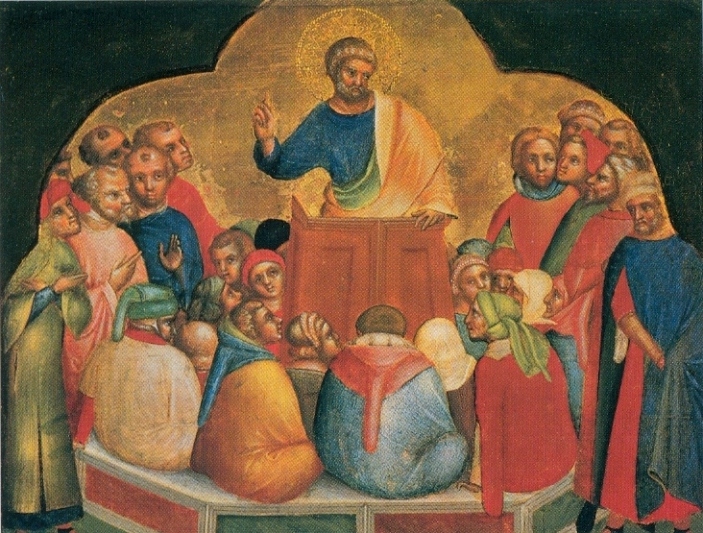
Apostle Peter Preaching by Lorenzo Veneziano, 1370 (acquired from Wikimedia Commons)

Recently, I reviewed perspectives on the office of the papacy from both the Catholic Church and a current Orthodox view. I'll begin with the Orthodox view, as articulated by Orthodox Metropolitan Kallistos Ware in early 2011 (all of his quotes herein come from between 28:00-47:00 of this recording). He believes the matter of the papacy to be the critical foundation toward unity on all divergent views of the Catholic and Orthodox Churches:
I truly believe that if we Orthodox and Catholics can make genuine progress on the way we understand primacy, then most of the other issues that arise between us could be solved.
Praying for the Church, it was Christ to the Father petitioning "that they may be one, even as we are one." (John 17:12) At the heart of all the councils and documents, which can sometimes give the appearance of imprudent bureaucracy, the goal here is one of love. This is the ultimate goal of every action of any Christian from the highest hierarchical level to the lowest lay level in every aspect of life. These two Churches have so much in common and recognize the validity of each others' priesthood and the sacrament of unity, the Eucharist. (cf. Joint International Commission, #13, 1993) Like Metropolitan Ware and all of the recent Popes, I have a certain optimism toward reconcilement of the two Churches. (See also comments on Pope Benedict XVI and Pope Francis I on Orthodox relations in prior post.)

CATHOLIC-ORTHODOX AGREEMENT ON THE PAPACY
Metropolitan Ware begins with a reference to The Ravenna Statement, a 2007 joint document between officials of the Catholic and Orthodox Churches regarding the primacy of the Pope, the Bishop of Rome:
In the Ravenna Statement it is stated unambiguously, "The fact of primacy at the universal level is accepted by both East and West." And that statement was endorsed by all the delegates, the Orthodox as well as the Catholics. …  Now, this statement stressing the existence of universal primacy is the first time, at any rate in recent history, that the Orthodox Church at a high official level, has affirmed in principle, the universal primacy of the Bishop of Rome. …  But the question then arises, what kind of universal primacy is meant? How is it to be interpreted?
We begin with this common point: the Bishop of Rome exercises a "universal primacy." Both the "East" (Orthodox) and "West" (Catholics) hold to this basic statement. The extent of what that means remains in negotiation. Metropolitan Ware nevertheless believes The Ravenna Statement is a crucial document in reconciling the Catholic and Orthodox understanding of the papacy because it cites an ancient canon especially revered by the Orthodox:

[T]he statement of Ravenna offers us a precious guideline. It appeals to the 34th apostolic canon. Now, I don't think the apostolic canons, which are 4th century in date, are particularly well known in the western canonical tradition. But for the Christian East, the apostolic canons have always been held in very high regard, especially the 34th apostolic canon, which is seen as the touchstone for primacy. … Now, the canon says, "The bishops of each province must recognize the one who is first––" protos is the Greek word "––the one who is first among them, and consider him to be their head. And they must not do anything important without his consent. But the first, the protos, cannot do anything without the consent of all."
In other words, Metropolitan Ware believes reconcilement on the papacy can be achieved if this mutual dependence of sorts, as articulated in Apostolic Canon 34, be harmonious with any view of papal primacy. 

DIFFICULTIES
Consider a final, lengthier quote from the Metropolitan on what remains unresolved regarding this canon and Catholic teaching:
The 34th apostolic canon suggests a relation, a mutual relation, between the one who is first and the other bishops. The protos, the head, the first, is not to do anything without consulting the others. But the others are not to do anything without consulting him. So the pattern here is mutuality, reciprocal concord, co-responsibility, interdependence. So if we apply this to papal primacy, it means that the members of the episcopal college and equally the patriarchs of the East cannot act without their head, the Pope. But equally, the Pope cannot act without the members of the episcopal college and the Eastern patriarchs. Now, I wonder how far such an understanding of papal primacy can be reconciled with the decrees of the first Vatican council, or, for that matter, of its successor Vatican II. In the dogmatic constitution on the Church, Lumen Gentium, the document of Vatican II, it is clearly said that the college of bishops cannot act without its head the Pope, whereas the Pope can very well act without the college, section 22. In the words of the nota explicativa praevia [an appendix to Lumen Gentium], section 4, "As supreme pastor of the Church, the sovereign pontiff can always exercise his authority as he chooses while the college of bishops acts only at intervals and only at the consent of its head." Now that doesn't seem to correspond to the kind of reciprocal relationship that the Ravenna statement envisages when it invokes apostolic canon 34. If it proves possible to reinterpret the authority of the Pope in the perspective of this canon, here is certainly an understanding of papal primacy that may well prove acceptable to the Orthodox Church. For this reason, I regard the Ravenna statement as a document full of hope. 

The bottom line from this Orthodox perspective is thus: The Orthodox can embrace a Catholic view of the papacy if it is in accord with apostolic canon 34. Yet Vatican I and Vatican II contain statements that seem unfaithful to canon 34. How can this be resolved?

At the first Vatican council was articulated the definition of papal infallibility. This dogma is at the heart of the Roman bishop making other dogmatic statements on faith or morals by virtue of his office. Elsewhere in Metropolitan Ware's talk, he expressed disapproving concern at the idea that a member of the Church could be able to so act as an island. Mutuality was his repeated concern.

BACK TO VATICAN I
I think it is helpful if we rewind even before the final decrees of Vatican I, and examine what led up to the decree on papal infallibility. Recently I finished reading through The Gift of Infallibility: The Official Relatio on Infallibility of Bishop Vincent Ferrer Gasser at Vatican Council I. This text is basically a behind-the-scenes look at Vatican I, as the bishops came to understand what was meant by the concept of infallibility as it related to the office of the papacy. Bishop Gasser oversaw a committee clarifying the defining paragraph on infallibility at Vatican I as well as reviewing suggestions submitted by other bishops. The value of this document is that it clarifies the intent of the final definition and perhaps dispels misinterpretations of the definition that were not intended by the bishops.

One thing I derived from reading this text is how papal infallibility is a gift of a singular office, yet intertwined in little-known ways with the Church itself and the Church's corporate infallibility.

Following are some observations of the text. References in parentheses are ebook locations.

THE INFALLIBILITY EXERCISED BY THE POPE DEMONSTRATES THE INFALLIBILITY OF THE WHOLE CHURCH
Bishop Gasser described an interesting theological perspective on papal infallibility as put forth by Cardinal Thomas Cajetan, a sixteenth century theologian:
[T]o use the words of Cardinal Cajetan––from the fact that when the Pope makes a judicial and definitive decision determining that it must be held as such by the Church then it is clear that we are all bound to accept his decision and that whoever pertinaciously clings to the opposite view is considered a heretic. Therefore the whole Church is able to err, following the decision of a Pope, if the Pope in such a definition is able to err. Therefore it must be believed that the promise of Christ made to the Church, viz., "The Holy Spirit will teach you all truth" (Jn 16:13), is fulfilled through one person with no more difficulty than through a multitude, thus preserving the divine order which governs the lower through the higher and the higher through the uppermost. (278-284) 
It is understood in the Catholic Church that the Church, due to the operation of the Holy Spirit, corporately has the gift of infallibility (i.e. to teach without error in defining for the whole Church matters of faith or morals, cf. Jn 16:13, et al). It is also understood in the Church to accept as infallible similar definitions of the Pope. Thus, in simple terms, the above paragraph means the following: If the Pope has the protection of infallibility, and the Church accepts his teaching, then the Church will remain infallible in doing so. However, if the Pope does not have the protection of infallibility, the Church could therefore accept an erroneous teaching of the Church, and thus the Church corporately would not have the gift of infallibility. This would violate the promise of the Spirit given to the Apostles. The Catholic Church is arranged such that the entire Church believes an infallible statement of the Pope, because it is ultimately an errorless statement of the Holy Spirit. And since the Orthodox have expressed certain agreement to papal primacy, this analogy by Cajetan may prove helpful since it ties the Pope to the other bishops.

Whether or not one accepts the Catholic concept of infallibility in the first place, I think there's an important point here not to be missed: The idea of papal infallibility rises or falls with the infallibility of the corporate Church.

THE POPE'S OBLIGATION IN MAKING A DEFINITION
In speaking to the bishops prior to the vote, Gasser describes this nuance:
[T]here belongs to the Roman Pontiff a separate infallibility. But in saying this we do not separate the Pontiff from his ordained union with the Church. For the Pope is only infallible when, exercising his function as teacher of all Christians and therefore representing the whole Church, he judges and defines what must be believed or rejected by all. He is no more able to be separated from the universal Church than the foundation from the building it is destined to support. (loc 492-496)
And:
[W]e do not separate the Pope, defining, from the cooperation and consent of the Church, at least in the sense that we do not exclude this cooperation and this consent of the Church. ... Therefore the Pope, by reason of his office and the gravity of the matter, is held to use the means suitable for properly discerning and aptly enunciating the truth. These means are councils, or the advice of the bishops, cardinals, theologians, et cetera. Indeed, the means are diverse according to the diversity of situations, and we should piously believe that, in the divine assistance promised to Peter and his successors by Christ, there is simultaneously contained a promise about the means which are necessary and suitable to make an infallible pontifical judgment. ... [W]e do not separate the Pope, even minimally, from the consent of the Church, as long as that consent is not laid down as a condition that is either antecedent or consequent. We are not able to separate the Pope from the consent of the Church because this consent is never able to be lacking to him. (loc 496-508)
In brief, what Gasser is saying here is that the Pope remains united to the Church and is "held to use" means necessary to formulate a definition (such as councils, bishop advice, etc.), but that this cannot be an absolutely mandatory aspect of the charism of papal infallibility. He subsequently explains why.

He says when we consider whether or not there necessarily must be formal consent of the Magisterium when making a definition, we reach the matter's "extreme point." By this, he means it is possible to discern the Church's teaching via existing sources of the faith, such as Scripture, antiquity, etc... In his own words, Gasser explains:
It is true that the Pope in his definitions ex cathedra has the same sources (fontes) that the Church has, viz., Scripture and tradition. It is true that the consent of the present preaching of the whole Magisterium of the Church, united with its head, is a rule of faith even for pontifical definitions. But from all that it can in no way be deduced that there is a strict and absolute necessity of seeking that consent from the rulers of the Churches or from the bishops. I say this because this consent is very frequently able to be deduced from the clear and manifest testimonies of Sacred Scripture, from the consent of antiquity, that is, of the holy Fathers, from the opinion of theologians and from other private means, all of which suffice for full information about the fact of the Church's consent. (loc 591-596)
In saying there is not a "strict and absolute necessity" of formal consent, Gasser's above caveat seems to be a stereotypical view of the papacy – that the Pope can and will operate in a rogue manner, as if alien to the Church, and could, in theory, violate a united voice from the Church. Yet what is the context of this statement? It is immediately preceded by the idea that  consent of other bishops is a "rule" for papal definitions. And we know from other statements in Gasser's presentation, that Magisterial consent is a rule because Magisterial consent is a means by which the Holy Spirit speaks to the Church. Recall how he quoted Cajetan saying "'The Holy Spirit will teach you all truth,' is fulfilled through one person with no more difficulty than through a multitude..."

In my assessment of Gasser's argument, he does not wish to impose a formal consent from the Magisterium when the Pope is able to clearly deduce the will of the Church from pre-existing Church teaching. If the Pope ever exercised his office in this way, I would submit that consultation of Scripture and pre-existing Church teaching remains faithful to Metropolitan Ware's belief that the Pope must not make decisions by himself, in accord with Apostolic Canon 34. If a matter is "clear" in the teaching of "antiquity" or "Scripture," the Pope would remain faithful to his peers in consulting sources they also deem authoritative. And, in consulting Scripture and other Tradition, the Pope would indeed be consulting the word of God in writing and through the words of bishops preceding him. In neither case, be it acquiring formal consent or informal consent via antiquity, the Pope does not act alone.

Fr. James T. O'Connor, translator of the Relatio, summarizes this aspect of Gasser's presentation:
Although the Pope is morally bound to do everything prudently necessary to prepare for a definition of faith, there is no juridical necessity for him to prepare the definition in any specific way, nor is his definition once proclaimed subject to review or approval by the other bishops or the faithful.
If there is to be reunion with the Orthodox Church on the matter of the Papacy, could this "moral" obligation of the Pope to consult the other bishops on a definition be a means? In other words, when the Church voted on papal infallibility in the context of Gasser's presentation, those at Vatican I passed on including a "formal" or "juridical" imposition on the Pope to consult other bishops while at the same time understanding him to have a moral obligation and service to that which the Spirit has revealed through the corporate Church. Could a non-juridical obligation of some sort be that which satisfies the requirements in Apostolic Canon 34 as described by Metropolitan Ware?

Since the Pope has a moral obligation to consult the Church, even though not a "mandatory" one, could the comparison be made to God not being required to come incarnate, mandatorily, but we can be assured that He will because it is most fitting? Can we be assured that the Holy Spirit would likewise teach through the Church and papal office by ensuring due diligence?

Let's take one more look at some of the statements above that at least lean toward Apostolic Canon 34:

  • The Pope is "no more able to be separated from the universal Church than the foundation from the building it is destined to support" when exercising his "function as teacher."
  • The Pope "is held to use the means suitable for properly discerning and aptly enunciating the truth."
  • "[T]he consent of the present preaching of the whole Magisterium of the Church, united with its head, is a rule of faith even for pontifical definitions."
  • "[T]the Pope is morally bound to do everything prudently necessary to prepare for a definition of faith."

Could this obligation to which the Pope is "held," this responsibility to consult the Church to which the Pope is "morally bound," be the key to reconcilement with the Orthodox Church? If not the solution, I would submit that these seeds underlying the definitions of Vatican I and of Apostolic Constitution 34 may be those that germinate into united maturity.

A CONCRETE EXAMPLE
In closing, it might be worth noting that the Pope has explicitly exercised this obligation in writing. In 1995, Pope John Paul II made a definitive statement about the grave immorality of abortion. In his statement, which cites the authority of the office from whence he spoke, he specifically cites having consulting the voice of his peers:
Therefore, by the authority which Christ conferred upon Peter and his Successors, in communion with the Bishops-who on various occasions have condemned abortion and who in the aforementioned consultation, albeit dispersed throughout the world, have shown unanimous agreement concerning this doctrine–I declare that direct abortion, that is, abortion willed as an end or as a means, always constitutes a grave moral disorder, since it is the deliberate killing of an innocent human being. (Pope John Paul II, Evangelium Vitae, 62, 1995)
You see the Pope articulating that what he is asserting is something already unanimously voiced by the Magisterium. His statement, according to his own declaration, is not made in isolation from the bishops. It is a statement communicating what those bishops had previously and then articulated.

Saturday, September 21, 2013

On Reconciliation: Can virginity be restored?

THE QUESTION
Sometime during listening to Catholic radio archives discussing families, college kids, and the issues of the day, I thought it worthwhile to take a theological look at the question: Can virginity be restored?

Here's the short answer: If given in marriage, no. If given outside of marriage, yes.

Now, an event in history cannot be changed. But in the context of this analysis, the physical actions are not the ultimate focus. In Catholic teaching, the sexual faculties and the giving of the self in that way to another is something which belongs within the institution of marriage. From the Catechism:
Sexuality is ordered to the conjugal love of man and woman. (CCC#2360) The acts in marriage by which the intimate and chaste union of the spouses takes place are noble and honorable; the truly human performance of these acts fosters the self-giving they signify and enriches the spouses in joy and gratitude. (CCC#2362) [S]pouses share in the creative power and fatherhood of God. (CCC#2367)
The sacrament of marriage is seen as the image of Christ as bridegroom wedded to his only bride, the Church (Theology of the Body 91, et al).

In other words, the gifts of our gender and sexuality are properly exercised within marriage. In so doing, the spouses express gratitude to the Creator who gave the gifts. Thus, virginity given in marriage does not cause any spiritual damage to the involved spouses. Such giving of virginity cannot be "repaired" or "restored" because no damage occurred in its giving.

The loss of virginity outside of marriage is a different story. Because it involves the use of the sexual faculties in a way reserved for marriage, damage is caused to the soul. Sin takes place. It is in this sense that the virginity lost can be restored. And it is only this sense that is of ultimate consequence.

This involves the heart of the Gospel message:
The Gospel is the revelation in Jesus Christ of God's mercy to sinners. The angel announced to Joseph: "You shall call his name Jesus, for he will save his people from their sins." (CCC#1846)
In his earthly ministry, Christ breathed on the Apostles and said, "If you forgive the sins of any, they are forgiven; if you retain the sins of any, they are retained." (John 20:23) Many Catholic apologetic articles can be found on this subject (e.g. here or here), but suffice it to say, this is an important passage in understanding that Christ installed the sacrament of reconciliation (aka penance, confession). Christ exercises his forgiveness through the priest.

So the crux of this essay is this: The giving of virginity in a sinful way causes damage that can be repaired by Jesus Christ who gave the Church the healing sacrament of reconciliation.

Think of what happens when someone incurs an injury, say a broken bone. Doctors can reset this bone such that it heals and restores the bone to its original status and strength. Sin likewise causes damage to the soul. It is Christ who repairs this damage.

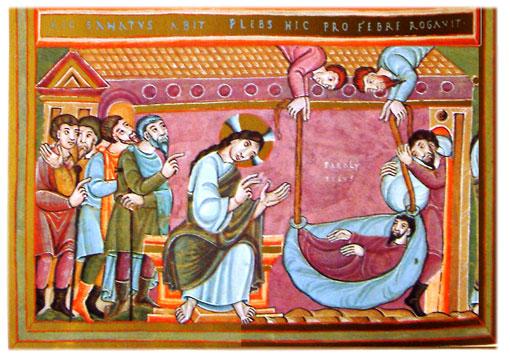
Healing of the Paralytic, Codex Egberti

ANALOGY OF THE HEALING OF THE PARALYTIC
The figure of physical healing as the sign of spiritual healing is evident in Scripture. For example, in Mark 2, there is the story of the paralytic lowered through the ceiling. Jesus tells the paralytic, "My son, your sins are forgiven." The scribes there are disturbed and question who but God can forgive sins. Jesus then gives them the physical sign that he has the power to forgive sins which cannot be seen with the eyes. He says to the scribes, "But that you may know that the Son of man has authority on earth to forgive sins" and then he says to the paralytic, "I say to you, rise, take up your pallet and go home." The paralytic rises and walks.

Jesus juxtaposes the physical healing with the forgiveness of sins. Christ removed the man's physical affliction so that the audience would believe he removed the man's spiritual affliction. This is why if one illicitly loses one's virginity, one should know that this can be restored by Christ in the sacrament of reconciliation.

Here are a couple more Church references demonstrating this teaching:
The whole power of the sacrament of [reconciliation] consists in restoring us to God's grace and joining us with him in an intimate friendship. (CCC#1468)

[W]ell may those sinners who have stained the white robe of their sacred baptism fear the just punishments of God. Their remedy is "to wash their robes in the blood of the Lamb"—to restore themselves to their former splendor in the sacrament of Penance. (Pope John XXIII, Paenitentiam Agere, 14)
And so, the Church, operating by the power of Christ, offers those authentically approaching the sacrament of reconciliation true healing of their sin, be it a loss of virginity outside of marriage or any sin. A soul can be restored to a newness, a "former splendor," as if the sin had never occurred. In the spiritual sense, which is the only one of eternal consequence, the soul having sinfully forfeited his or her virginity has recovered grace lost. The damage is repaired. As in the story of the paralytic, the affliction on the person is removed. Gone. The the true penitent receiving the sacrament is united to God destined to dine at the eternal banquet in heaven.

Thursday, August 29, 2013

Can you go to hell for the "flimsiest of reasons"?
A look at invincible ignorance and a forgotten value of conversion


THE QUESTION
On the August 27, 2013 Coast to Coast radio show George Noory interviewed Catholic historian
Charles Coulombe on a variety of topics during the last three hours of the show. Coulombe was consistently excellent, had his facts about Church teaching straight, expressed himself succinctly and charitably, and very well-represented the Church to members of an audience that might not otherwise ever hear an accurate portrayal of Church matters.

After listening to the entirety of the interview, I only wished he would have expounded more on one issue. The issue was raised by a caller, Ray in Niles, OH, who asked the following (emphasis mine):
When we say that people who are evil would deserve hell and those who lead virtuous lives deserve heaven, that makes rational sense. But the problem I've always had with the
Church and with Christianity in general is that you're condemned to hell for the flimsiest of reasons. For example, you're required to believe a matter of fact that Christ was divine and the Incarnation. Now let's suppose a person leads a virtuous life but doesn't happen to believe that. That doesn't make them evil. I mean, if I believe, for example, that the Eiffel Tower is in London, England and not Paris, I'm wrong. But I'm wrong about a matter of fact. I'm not evil in making that. Now the Church holds you responsible for knowing things that you can't possibly know. We hold people responsible when we're in a position to say to them, "You acted against your better judgment. You ought to have known better." But if one doesn't believe in the Incarnation, or the divinity of Christ, is one going against one's better judgment?And furthermore, what constitutes a judgment has to do with an accident of birth. People who are born into Roman Catholic families tend to be Roman Catholic. People who are born into Muslim families tend to be Muslim. People who are born in Jewish families tend to be Jewish. And so on. Are they expected to know that the other religion is true? And how can they know that? If you can't know what you're required to believe, then how can you be eternally damned for getting it wrong? That just doesn't make any rational sense.
Coulombe began by pointing out the tremendous number of fallen away Catholics as evidence that people don't necessarily stay where they are. True or not, the caller's ultimate claim was that it was possible, according to Church teaching, that a person unable to know what to believe would be condemned for not believing it. The gist of the caller's question is not uncommon. Coulombe made other fair points related to the fallen human nature of man, and Christ as the escape from a futile position. However––although it is easy for me to say not under the constraints of radio time as was Coulombe––I wished he would have expounded on the concept of "invincible ignorance."

To put it briefly, the caller was incorrect that the Church teaches that a person will be condemned to hell for not knowing something he "can't possibly know."

THE ANSWER
In Catholic theology, there exists a doctrine commonly called "invincible ignorance" or some similar paraphrase. The Catechism offers descriptions. Beginning in paragraph 846 is the following: "all salvation comes from Christ the Head through the Church which is his Body." From there, we read the important subsequent paragraph (emphasis mine):
This affirmation is not aimed at those who, through no fault of their own, do not know Christ and his Church: Those who, through no fault of their own, do not know the Gospel of Christ or his Church, but who nevertheless seek God with a sincere heart, and, moved by grace, try in their actions to do his will as they know it through the dictates of their conscience - those too may achieve eternal salvation. (CCC#847)
That paragraph alone debunks the caller's claim that the Church teaches the condemnation of those who don't formally know Christ. A person who "through no fault of their own" would be considered "invincibly ignorant." In other words, they did not receive a legitimate opportunity to know and believe in the Christ, whom alone is the door to salvation.

Essentially, if a person was invincibly ignorant of the truth of Christ, and if they attained salvation, they would still be incorporated into "the Church which is his Body" (CCC#846), but in an informal sense. Not with their lips or through receipt of the sacraments would such a person express his faith in Christ. But by their "sincere heart" and by their move "to do his will as they know it" (CCC#847) is their expression made. And it should be noted that even this action is done by "grace," which is God's gift, God's initiative. It should also be noted that the Church does not teach such persons certainly "will" go to heaven, but "may" in some way known to God.

In other words, the Church does not teach that God plays little games of "gotcha" and sends someone to hell for a "flimsy" reason, such as a person never having had an opportunity to believe in the usual sense. What constitutes true "ignorance" may only be known to God and the soul in question. Perhaps it is possible even for someone who was preached the gospel explicitly to remain invincibly ignorant due to various emotional or mental impediments. On the other hand, a person who heard the gospel may falsely convince themselves that they did not receive enough evidence (or grace) and proudly claim that they were not adequately evangelized. We could speculate, but defining an ignorance that can vary from soul to soul is not the purpose of this post, if it were even possible.

The theology of salvation and an "informal" faith in Christ is not new. For instance, in the Old Testament, we are told Elijah, who lived long before the Incarnation of Christ, was taken to heaven (2 Kg 2:11). Paul eludes to the mercy shown to him because, as he says, he "acted ignorantly in my belief" when he persecuted Christians (1 Tim. 1:13)  The Early Church Fathers likewise made similar statements about ignorance or informal incorporation into the Church, which is Christ's body. St. Augustine stated, "in the ineffable prescience of God, many who appear to be outside are within," incorporated by "wish or desire," while "many who seem to be within are without." (St. Augustine, quoted in De Lubac, The Splendor of the Church, p. 212). The 2nd century Church Father, Justin Martyr, went so far as to say those who lived before Christ either embraced or persecuted Christ in a mystical way (emphasis mine):
We have been taught that Christ is the first-born of God, and we have declared above that He is the Word of whom every race of men were partakers; and those who lived reasonably are Christians, even though they have been thought atheists; as, among the Greeks, Socrates and Heraclitus, and men like them; and among the barbarians, Abraham, and Ananias, and Azarias, and Misael, and Elias, and many others whose actions and names we now decline to recount, because we know it would be tedious. So that even they who lived before Christ, and lived without reason, were wicked and hostile to Christ, and slew those who lived reasonably. (St. Justin Martyr, First Apology, 46) 
Father William Most compiled a number of similar citations in this article under the subhead "Broad texts of the fathers" as well as other citations from the Magisterium.

A PARALLEL THOUGHT ON "FLIMSY" DOOM
In Catholic theology and Biblical language, it is sometimes said a wicked soul will experience "death," not in the sense of temporal death, but the death of the soul, a "second death" (Rev. 2:11; Rev. 20:6-14), where the fires of hell are eternal.

Barring a special revelation, we cannot "observe" heaven or hell in the way we can the environment around us. Keep in mind the Coast to Coast caller's difficulty believing in the idea of hell because of, what was to him, the "flimsy" way one can get there. The caller, though his premise was erroneous, believed if one went to hell for a "flimsy" reason, it therefore didn't make "rational sense." He was not willing to believe such a doctrine based on the unequal proportion between a hypothetical error in ignorance that could result in a disproportionate fate. Keep that in mind in the following thought exercise.

Let's say a man comes home from a long day's work and decides to make himself a bowl of soup. He turns the knob on his gas stove. He had a stuffy nose that day, and didn't smell the gas leak that had accumulated throughout the day. Ignorant of the gas leak, he blows up. In keeping with the reasoning of the caller, should a person trying to cook soup deserve to die? Where is the rational sense in the consequence of death, when the subject was ignorant that death would result from his action? Where is the proportion? Would the caller deny that the man had blown up based on the flimsy reason why the man was killed?

The point of the thought exercise is to demonstrate the fallacy of the caller's conclusion in having a "problem" with the Church, even if his theological understanding of Church teaching had been correct. At best (or worst), he would have to admit that a "flimsy" reason for going to hell would simply parallel the empirical evidence we have of people dying a temporal death due to ignorance.

WHY EVANGELIZE?
One may ask, then, if a person may be granted lenience for his ignorance of Christ, isn't it safer not to evangelize? I would answer no. Here's one reason why.

In a previous post, I reviewed Church theology on How the Eucharist benefits the world. In brief, those who receive the Eucharist are receiving something divine into themselves, something supernatural that transforms and effects grace on nature. The very celebration and receipt of the Eucharist draws souls throughout creation and brings grace into the souls receiving the sacrament. Thus, even if someone would be saved in an informal way, as a result of receiving mercy due to his "invincible ignorance," the very absence of that person's formal incorporation to the Church renders that person a non-participant in the sacramental delivery of grace.

An ancient Church prayer reads, "O sacred banquet in which Christ is received as food, the memory of his Passion is renewed, the soul is filled with grace and a pledge of the life to come is given to us." (cf. CCC#1402). Through all the sacraments, especially through the Eucharist, is received grace to "enlighten and nourish Christian activity." (CCC#2031) Though the Spirit can deliver grace in any way, the Church teaches the power of grace through the sacraments.

The very foundational call of Christian activity is to love God and neighbor. Receipt of the sacraments fosters that love. Thus, in the Catholic theology which we believe based on the promises of Christ, there is a true value to the entire Church and to the entire world when one formally incorporates into the Church. There is a value that extends beyond the converting individual.

And as the Catechism concludes in the section on invincible ignorance and salvation only through the Church:
Although in ways known to himself God can lead those who, through no fault of their own, are ignorant of the Gospel, to that faith without which it is impossible to please him, the Church still has the obligation and also the sacred right to evangelize all men. (CCC#848)

Wednesday, August 21, 2013

Gov. Christie gets Church teaching on homosexuality wrong

Photo of NJ Gov. Chris Christie by Luigi Novi, courtesy of Wikimedia Commons

An August 19, 2013 press release from New Jersey Governor Chris Christie announced the governor's signing of a ban on reparative therapy for minors. As a brief segue, the psychology involved in homosexual reparative therapy does not seem entirely consistent according to a variety of studies, although states like California and New Jersey have chosen scientific sides.* But the controversy of bans on reparative therapy, even on willing participants, and an examination of the variety of extant psychological disorders are not the purpose of this post.

In the NJ press release is included the following portion of a transcript from 2011 between the governor and CNN's Piers Morgan.
Piers Morgan: Is homosexuality a sin?
Governor Christie: Well my religion says it’s a sin. I mean I think, but for me, I’ve always believed that people are born with the predisposition to be homosexual. And so I think if someone is born that way it’s very difficult to say then that’s a sin. But I understand that my Church says that, but for me personally I don’t look at someone who is homosexual as a sinner.
Christie is a Catholic. When he says that his religion says "homosexuality" is a sin, he is wrong. When he says the Church calls a person who is simply "born that way" to be in "sin," he is wrong. Let's review the correct teaching again in these excerpts from the Catechism (full paragraphs here).
CCC#2357 Basing itself on Sacred Scripture, which presents homosexual acts as acts of grave depravity, tradition has always declared that "homosexual acts are intrinsically disordered." They are contrary to the natural law. They close the sexual act to the gift of life. They do not proceed from a genuine affective and sexual complementarity. 

CCC#2358 The number of men and women who have deep-seated homosexual tendencies is not negligible. This inclination, which is objectively disordered, constitutes for most of them a trial. They must be accepted with respect, compassion, and sensitivity. Every sign of unjust discrimination in their regard should be avoided. These persons are called to fulfill God's will in their lives and, if they are Christians, to unite to the sacrifice of the Lord's Cross the difficulties they may encounter from their condition.


CCC#2359 Homosexual persons...can and should gradually and resolutely approach Christian perfection.
Let's summarize the 3 excerpts:
2357 - Homosexual ACTS are sinful.
2358 - Homosexual persons should be treated with love.
2359 - Homosexual persons can attain Christian perfection.

Yet Christie claims to contradict his Church when he says he doesn't believe someone "who is homosexual" is a sinner. The Church's teaching on sexuality is consistent for any person––sexual behavior is appropriate only in a marital setting, must be open to life, etc. Acts of the body or indulgent acts of the heart contradictory to that environment are sinful. CCC#2352 includes the statement: "The deliberate use of the sexual faculty, for whatever reason, outside of marriage is essentially contrary to its purpose." It should be noted the Church is not merciless toward persons who may fall into sexual sin. Recently the Pope made the distinction of inappropriate judgment of persons, including those with homosexual leanings. And anyone who sins is embraced to receive the sacrament of reconciliation.

Let's look at another recent statement by a teacher of the faith, a Catholic Bishop (emphasis mine):
Church teaching is very clear that the homosexual inclination is not sinful and that same-sex attraction is not immoral, but that what we’re dealing with here is the distinction between the inclination and the conduct. ... Homosexual activity will not be condoned. (Bishop Robert Guglielmone of Charleston, May 27, 2013)
Christie is wrong. He is incorrect. As it is worded, his statement could cause scandal and false myths about the Church. If Christie does understand Church teaching and its gravity but simply rejects it, he has excommunicated himself latae sententiae. (For his part, Piers Morgan, who professes to be Catholic, has also demonstrated vitriol for Catholic teaching.)


*For example, see articles such as this from the National Catholic Register. Or read through the plaintiff's case (PDF) in the California ban. In their argument, they point out the reliance of the defendant on the American Psychological Association's 2009 Report of the Task Force on Appropriate Therapeutic Responses to Sexual Orientation. The studies by that task force include the following statement: [S]ame-sex sexual attractions and behavior occur in the context of a variety of sexual orientations and sexual orientation identities, and for some, sexual orientation identity (i.e., individual or group membership and affiliation, self-labeling) is fluid or has an indefinite outcome. Other state-dismissed research can be found in the works of licensed therapists such as the participating plaintiffs in that case David Pickup, Dr. Christopher Rosik, Dr. Joseph Nicolosi, Robert Vazzo, and the National Association of Therapy of Homosexuality (NARTH), the American Association of Christian Counselors, et al.

Monday, July 29, 2013

Media appears unaware that Pope Francis' statement on judging "gays" is nothing new


Today, headlines abounded throughout the news media that Pope Francis said he would not "judge" gay priests. From this article at CatholicNews.com, the Pope's expanded quote in question reads:
A gay person who is seeking God, who is of good will -- well, who am I to judge him? The Catechism of the Catholic Church explains this very well. It says one must not marginalize these persons, they must be integrated into society. The problem isn't this (homosexual) orientation -- we must be like brothers and sisters. The problem is something else, the problem is lobbying either for this orientation or a political lobby or a Masonic lobby. (see bottom of post for links to full English translation of interview)
A BBC article, among others, expressed surprise at such a notion, stating: "The Pope's remarks are being seen as much more conciliatory than his predecessor's position on the issue."

Briefly, I'll point out the problem with the headlines that do not mention the person in question's pursuit of God and good will, which is different than the insinuation that the Pope doesn't judge the behavior of any "gay" person. Most headlines focus only on the first sentence, and only some articles expand on other parts of his statement.

But why would such a statement even be a headline? Even in the context of the Pope's comments, he refers to his comment being a reflection of the Catechism, which reads:
2358 The number of men and women who have deep-seated homosexual tendencies is not negligible. This inclination, which is objectively disordered, constitutes for most of them a trial. They must be accepted with respect, compassion, and sensitivity. Every sign of unjust discrimination in their regard should be avoided. These persons are called to fulfill God's will in their lives and, if they are Christians, to unite to the sacrifice of the Lord's Cross the difficulties they may encounter from their condition.
The media's reaction to Pope Francis' statement reveals a serious ignorance about Catholic teaching. Some stories insisted Pope Francis exhibited a new "tone," toward those with homosexual inclinations, attempting to contrast him with Pope Benedict XVI. Yet, in 2003, Pope Benedict (then Cardinal Ratzinger) provided almost the identical sentiment while citing the Catechism:
[A]ccording to the teaching of the Church, men and women with homosexual tendencies “must be accepted with respect, compassion and sensitivity. Every sign of unjust discrimination in their regard should be avoided”. They are called, like other Christians, to live the virtue of chastity. (Cardinal Ratzinger, Considerations Regarding Proposals to Give Legal Recognition to Unions Between Homosexual Persons, 2003)
Years earlier, Cardinal Ratzinger wrote a letter to bishops regarding the pastoral care of homosexual persons, in which he wrote:
The characteristic concern and good will exhibited by many clergy and religious in their pastoral care for homosexual persons is admirable, and, we hope, will not diminish. Such devoted ministers should have the confidence that they are faithfully following the will of the Lord by encouraging the homosexual person to lead a chaste life and by affirming that person's God-given dignity and worth. ... The God who is at once truth and love calls the Church to minister to every man, woman and child with the pastoral solicitude of our compassionate Lord. (Cardinal Ratzinger, Letter to the Bishops of the Catholic Church on the Pastoral Care of Homosexual Persons, 1986)
As Pope Benedict, he said the same, again reflecting the basic Catechism teaching:
Deep-seated homosexual tendencies, which are found in a number of men and women, are also objectively disordered and, for those same people, often constitute a trial. Such persons must be accepted with respect and sensitivity. Every sign of unjust discrimination in their regard should be avoided. They are called to fulfil God's will in their lives and to unite to the sacrifice of the Lord's Cross the difficulties they may encounter. (Pope Benedict XVI, Concerning the Criteria for the Discernment of Vocations with regard to Persons with Homosexual Tendencies, 2005)
Both Pope Francis and Pope Benedict reflected the exact same sentiment as can be read in the Catechism. And Pope Benedict's words were even placed in official Church documents as compared to Pope Francis' comments off the cuff. Other statements by other bishops or Popes in history can be found to express a similar sentiment. Yet when Pope Francis articulated it recently, the media acted surprised. Where was the media in 1986 or 2005 to isolate a quote by Pope Benedict about gays stating, "Pope says gays worthy of love and dignity" or "Pope criticizes those who discriminate against gays." Why does the BBC, quoted above, think Pope Benedict's attitude was any different that Pope Francis'?

If the media had then desired to paint that particular caricature of Pope Benedict XVI, they could have done so, as they have with Pope Francis. But they were either negligent in recognizing Pope Benedict's words, or perhaps they consider the current social climate opportune to accent any comment that could be construed as favorable to a particular ideology, such as the current movement to certify "gay marriage" as a real institution. That could be why they did not isolate his sentence a moment later and come up with what would have been an accurate headline such as "Pope Francis condemns those who 'lobby' for homosexual behavior." Instead, Pope Francis may be seen as the media's utilitarian Rorschach blot from whom they have decided to draw whatever appearance they choose.

MEANING OF "JUDGE"
It is apparent in reading headlines such as the embarrassingly inaccurate one at the Huffington Post on this issue reading "Breakthrough: Pope OK with Gays," that some people interpret not "judging" in this context as "approval" of gay behavior.

It does not take much effort to read the next sentence in the Pope's statement that the Church's position is clarified in the Catechism. Quoted above is CCC#2358 on treating all persons with love, including those with homosexual tendencies. The preceding paragraph, CCC#2357 states: "[H]omosexual acts are intrinsically disordered. ... Under no circumstances can they be approved." So we have two teachings: homosexual acts are intrinsically disordered sins and we are still called to love those with homosexual tendencies. Also critical here is the following:
CCC#1861 Mortal sin is a radical possibility of human freedom, as is love itself. It results in the loss of charity and the privation of sanctifying grace, that is, of the state of grace. If it is not redeemed by repentance and God's forgiveness, it causes exclusion from Christ's kingdom and the eternal death of hell, for our freedom has the power to make choices for ever, with no turning back. However, although we can judge that an act is in itself a grave offense, we must entrust judgment of persons to the justice and mercy of God.
That's what the Catechism states. The Catechism is where Pope Francis referred those to understand the meaning of him not passing judgment on persons, even if one has judged those persons to have committed objectively mortal sins. It seems difficult for some in the media to understand that it is possible to love someone without approving of their every behavior. In fact, sometimes the loving response to another is to disapprove of their behavior. But perhaps this concept is alien to some persons, causing them to automatically misinterpret the Pope's meaning of not judging.

THIS INCIDENT SHOWS THE RELEVANCE OF THE CHURCH
Just a final observation––I think the matter of this media frenzy today demonstrates the relevance of the Church. Even though comboxes or members of the media scoff at the Church, claiming her to be irrelevant, their ear remains turned even as they look the other way. It demonstrates the moral authority the Church still bears, even as there exists irrational cries to silence her. Many members of the media appear almost giddy that the Pope may have approved homosexual behavior (which he did not). Could there be a psychology, that though some people with their lips say they don't care what the Pope says, they subconsciously desire the support of the Pope because they recognize the moral authority the Church still bears? Even if the media is trying to "use" the Pope as utilitarian to advance a particular cause, in their abuse of the Pope's words, they show that they recognize the power in having the Church's voice on their side. Perhaps it is telling that this is at least the third time the media has misrepresented Pope Francis' words: on atheism, Purgatory, and now homosexual behavior.

See also:
What Pope Francis really said about gays - and no, it's not new by Fr. Jonathan Morris
7 things you need to know about what Pope Francis said about gays by Jimmy Akin
Added 8/5/13: Here is Zenit's English translation of the entire Pope Francis interview on the Brazil flight (part 1 and part 2)

.

Monday, July 15, 2013

Replies to "gay marriage" arguments 2

Read the original Replies to "gay marriage" arguments here.

The Marriage of Tobias and Sarah by Havickszoon (1673)

Following are two additional arguments set forth by proponents of gay "marriage" and thoughts on each.

God loves everyone, including gay people. Therefore if you want to be godly, you should endorse gay "marriage." If you don't, you are a "hater."
The premise of this argument may be tricky to spot because there is a subtle switch from the premise to the conclusion. To rephrase the above argument, it claims: God loves everyone, therefore, God condones anyone's behavior because to love includes condoning behavior. However, this is clearly fallacious thinking. It is perhaps a breed of the fallacy of equivocation in which two different concepts, a person and the morality of a behavior, are wrongly equated. In fact, in the above argument, the arguer himself does not condone anyone who does not endorse gay "marriage," which ironically suggests that arguer himself does not love everyone according to the standard of the very argument he proposes. It is also extremely easy to find the label "hater" thrown about in forums or comboxes by supporters of gay "marriage."

Additionally, a reasonable person can see that condoning behavior is not always an act of love. If a child steals cookies from another child's lunch bag, his mother would not exhibit love to that child if she condoned his theft as acceptable. If she disapproved of his behavior, would that mean she did not love her child? Would it mean she hated her child? Of course not. By telling the child it is not okay to steal, the mother exhibits love. In other words, it is not an act of love to confirm someone in a lie or illicit act.

The teaching that God loves everyone is considered a teaching of Christian scripture and often used by proponents of gay "marriage" in the above context. Yet even in Scripture, we can see God condemning, say, idolatrous behavior in ancient Israel, even if that practice was popular and widespread.

The Catechism teaches the following about persons who are confronted by same-sex attraction:
The number of men and women who have deep-seated homosexual tendencies is not negligible. ... They must be accepted with respect, compassion, and sensitivity. Every sign of unjust discrimination in their regard should be avoided. These persons are called to fulfill God's will in their lives and, if they are Christians, to unite to the sacrifice of the Lord's Cross the difficulties they may encounter from their condition. (CCC#2358)
The United States Conference of Catholic Bishops (USCCB) is aware of the sense of rejection that may be experienced by some with homosexual tendencies:
Essential to the success of ministry to persons with a homosexual inclination will be the support and leadership of the bishop and other pastoral leaders. A welcoming stance of Christian love by the leadership and the community as a whole is essential for this important work. This is particularly important because more than a few persons with a homosexual inclination feel themselves to be unwelcome and rejected. (USCCB, Ministry to Persons with a Homosexual Inclination, 2006)
So when it comes to matters of love, the Church is aware and should be given due credit for emphasizing the love that should be given to those who face same-sex attraction. Christians and non-Christians should be able to agree as a principle that human beings possess the dignity to be treated with love. However, as established, love is not defined by the approval of any behavior.

As well, the above argument does not confront whether or not a marriage can even occur without one man and one woman exchanging vows. It is the Church's position that it is impossible for a marriage to even occur without the proper ingredients.

It should also be noted that the Church does not condemn someone simply for being confronted with same-sex attraction. Just as the Church exhorts a single person, clergyman, or religious celibate, the Church exhorts those facing same-sex attraction to chastity and acknowledges their capacity to approach Christian perfection!
Homosexual persons are called to chastity. By the virtues of self-mastery that teach them inner freedom, at times by the support of disinterested friendship, by prayer and sacramental grace, they can and should gradually and resolutely approach Christian perfection. (CCC#2359)
Those who dismiss the Church's position without confronting the Church's theology on the dignity of persons and the communal complementarity of the created genders do a disservice. As radio host Al Kresta has been known to say, "A mark of intellectual maturity is to be able to represent your opponent's position in a way that your opponent would recognize as fair and accurate." Blurting out things like "bigot!", "you just follow a two-thousand year old book!", or similar interjections are unworthy arguments.


People are "born" homosexual. Therefore, gay "marriage" should be condoned.
This argument is related to the other buzz-phrase, "marriage equality," which claims homosexual "marriage" is the same thing as marriage between complementary genders. The thinking seems to be that since people are born heterosexual and are allowed to marry, therefore people who are "born" homosexual should be allowed to marry a person of their same gender.

There are at least a couple problems with this reasoning. The first is the lack of conclusive evidence that persons with homosexual tendencies are "born" with those tendencies. There are a number of scientific studies refuting the idea that genetics is the reason for homosexual tendencies, including the fact that many identical twins do not share the same sexual attractions.

Consider also the principle espoused in the above argument. It says, if a person is born with Tendency X, then society should condone any enterprise which allows them to perform Tendency X. But what if a person is born with a tendency that all or most of society recognizes as disordered? Some scientific studies show that the brains of criminals exhibit abnormalities in certain areas. Hypothesize for a moment that someone is born with a certain brain abnormality that tends that person toward some violent, criminal behavior. Now apply the above argument. It would say something like: If a person is born with violent, criminal tendencies, society should condone their behavior as acceptable.

In other words, whether or not a person is born with a certain tendency, does not tell us whether or not that tendency is beneficial for society, much less moral.

Consider also what such proponents of gay "marriage" are asking: that the union of two same-gendered people be recognized as marriage, on the grounds that the individuals are "born" that way. But if, as the Church argues, marriage is only possible with one man and one woman, it is irrelevant what sexual tendencies any individual is born with because marriage does not depend on that. To give an analogy similar to my Estonia analogy last post, let's say there is a full-grown adult, Skippy, who would like to be recognized as six-feet tall. However, Skippy is, in reality, five-feet tall. No matter what a court or legislature may say, they cannot "write" Skippy's height at six-feet and make it a reality. In the same way, neither the way a person is born, nor a government declaration can alter marriage as anything but the union of one man and one woman.


Related reading:
How redefining marriage harms society by Dr. Jennifer Roback Morse

Monday, July 1, 2013

Replies to "gay marriage" arguments


Following are common arguments in favor of so-called "gay marriage" and some thoughts on each. There are indeed many other arguments and replies one could consider on this issue besides what is covered below, but in the interest of brevity, I will limit this post to these.

First, let me caution against a knee-jerk response: none of this should be interpreted as some sort of "hatred" for persons who assert homosexuality. Rather, consider this: if marriage can only "occur" if the ingredients of one man committed to one woman are joined, then it is not "love" to confirm one's peers in a lie by endorsing something as marriage which is not marriage. The sensitivity of this issue among families and friends demands that people avoid a strictly "emotional" response to arguments presented rationally and in good faith. One can still be a proponent of marriage as it has been known for centuries and still exhibit love for anyone, regardless of opinions or behaviors.

If two people love each other, they should be allowed the same rights and benefits no matter their genders.
First off, everyone does have the same rights. All persons desiring to enter the institution of marriage must do so with a member of the opposite sex. That's what a marriage is. Proponents of marriage are not granting themselves any privilege for themselves that they would deny to anyone else.

Additionally, if special federal benefits should be granted to "two people who love each other," then any two people who love each other, platonically or otherwise, deserve those benefits. Two brothers, a brother and sister, a daughter and father, two cousins, two friends, etc... Any two people who "love each other" fit the criteria argued by many proponents of "gay marriage."

As a radio caller Christine from Indiana said on the June 27 Catholic Connection show with Teresa Tomeo: "When I was listening to a lawyer on CNN who was so excited about the ruling, and he said, 'Now this means that two people who love each other can, you know, get married and are equal.' And I said, well, I love my mother."

As many have also pointed out, the legal precedent at hand is establishing a basis for state-recognized polygamy, concubines, incest, "temporary" marriages, situational or contractual marriages, etc... Although one can find "gay marriage" supporters scoff at this slippery slope, we have already seen advocates for these kinds of "marriages" attempt to springboard on the current legal precedents. The principles advanced by "gay marriage" proponents are transplantable to these arrangements without needing revision.

It is discrimination to bar any class of people from receiving the same benefits of other married people.
Again, no one has special privileges regarding marriage denied to anyone else (see previous answer). Additionally, why is there no movement demanding that single people receive the same benefits demanded for "gay couples"? In refusing single people, all of whom "love" someone, such benefits, proponents of "gay marriage" by their own definitions are advocating for discrimination against a "class of people." The arguments set forth do not show cause for why "two people who love each other AND share genital activity" merit benefits verses two people who love each other and are otherwise still committed to that love for life.

Also, the above argument is essentially, "If person X wants Y, and someone else has Y, it's discrimination to deprive X of Y." Consider, for example, if I want to be recognized as a naturally born citizen of Estonia. However, I was not born in Estonia. Yet there are others who were born there. If I demanded a law to recognize me as a natural born citizen of Estonia, and if that law were enacted, it would not make me a naturally born citizen of Estonia because some realities are not affected by the stroke of a pen. Ultimately, it is faulty to automatically assume that any enterprise had by one person is automatically discrimination against someone else who does not possess the same enterprise.

If marriage must be open to procreation, then why are infertile or elderly couples of the opposite sex allowed to marry? Since they are, then procreation is not "necessary" for a marriage and therefore "gay couples" are no different than those couples.
There are a number of problems with this argument as well. Sometimes couples who were diagnosed or thought to be infertile due to a defect or old age are surprised to find themselves pregnant. Absolute infertility is not an infallible thing to diagnose. Just last month a woman went to the hospital with "back pain" to find herself giving birth to a baby she did not know she was carrying––and her husband had had a vasectomy besides.

Secondly, the opposite genders, by their nature, have procreative qualities. Any infertility is a degradation or malfunction of the body. For civil society to embrace the marriage of such a couple is not to say "marriage does not involve procreation." For reasons in the previous paragraph, fertility may still exist. That alone is reason to continue support for marriage between one man and one woman. And also, by still recognizing marriage only in male-female relationships, the entire idea of a procreative union is fortified culturally whether or not the couple themselves are ever able to conceive. They retain their share of maleness and femaleness in which fertility resides in the complementarity of genders. That children are conceived by a man and woman is a statement not requiring any specific couple to exemplify. It is the basic, natural structure of a generational society. The complementarity they embody does not escape their genders if one or both of them should have a physical insufficiency. The recognition of their union fosters an environment of other male-female marriages which would be fertile. Same-sex "marriages" do not represent the fertility of maleness and femaleness because one or the other is lacking. By their very nature, the union of the same gender is always impotent.

As well, no one seems to argue that a married couple that was once fertile is suddenly not married once they reach old age simply because they are diagnosed as infertile. Yet, like a newly wed elderly couple, they still represent the male-female union that is elsewhere fertile and encouraged. And in this way, the figure of their gender complementarity fortifies the normative fertility associated with the genders they represent. In fortifying the idea that marriage is between one man and one woman, the idea of the fertility associated with the complementary genders is likewise fortified.

Children raised by "married" gay couples do just as well or better as children raised by their mothers and fathers.
In theory, even if this was true, it would not make the union of any two of the same genders "a marriage." But this is not true. History and social science have produced much evidence that children end up more prone to broken homes or other problems when raised apart from one of their parents. (Examples: citizenlink, Univ. of Texas-Austin study and here, Crisis Magazine, etc. See below for more thoughts on faulty male-female marriages.

Concluding thoughts
Now, of course there are a number of broken male-female marriages resulting in plenty of children raised in poverty or prone to crime, etc... In Catholic circles, you will have found for many years, criticism of the breakdown of marriage preceding all this talk of "gay marriage." In May, TCV reviewed the 1880 encyclical Arcanum by Pope Leo XIII who warned against straying from committed male-female marriages and facilitating divorce or concubines. The boom of contraception in marriage has also led to the further objectification of spouses, as predicted by Pope Paul VI, and hyper physically-sexualized the institution of marriage while championing infertility.

As I said in that May post, marriage has not degraded because the culture listened to the Church, but because the culture has scoffed at and failed to heed the warnings of the Church. A point being that support for "gay marriage" is not a remedy for the poisoned well of marriage. Rather, a number of arguments for "gay marriage" are founded on many of the decayed attributes of marriage in the last centuries, which are themselves repeats of ancient marital troubles in various times and cultures.

From a civil perspective alone, it is in the best interest for the state to recognize and foster a citizenry in which children have the best chance to be raised, in the order of nature, by both their mother and father. Regarding marriage, that is what the goal of a society seeking stability should be.

And finally, this is not heard much in the media, but I have not heard many people consider whether or not proponents of "gay marriage" are advancing a particular religious belief. Marriage is not an observable, quantifiable thing you can contain in a beaker in a laboratory. Proponents of marriage throughout the centuries recognize it as a divine institution because one can observe and verify the complementarity and potency of the genders that have been created. Proponents of "gay marriage," as we have observed, often base their arguments as reflections on the existing institution of male-female marriage. Is it fair to bring to the table whether or not proponents of "gay marriage" are imposing a state-sanctioned religion of sorts on the public?

(Added July 15, 2013: Read Replies to "gay marriage" arguments 2 here)

Image at top of post is Simon de Vos' Wedding at Cana, from Wikimedia Commons.

Friday, May 24, 2013

Media falsely represents Pope on atheism


What was said
It is reactions such as those in response to the Pope's recent homily that lead me to believe the Catholic Church is the most consistently misrepresented institution in the world. What did Pope Francis I say to result in headlines from secular media like:
Pope Francis: 'Even the atheists' can go to heaven (New York Daily News)
Pope Francis: Being an atheist is alright as long as you do good (The Independent)
Pope Francis Says Atheists Who Do Good Are Redeemed, Not Just Catholics (Huffington Post)
Pope lets atheists off the hook, saying Lord redeems us all (msn.com)
Here is what the Pope said during the March 22 homily in question (Recap at Vatican Radio; emphasis mine):
[T]he Lord has created us in His image and likeness, and has given us this commandment in the depths of our heart: do good and do not do evil...The Lord has redeemed all of us, all of us, with the Blood of Christ: all of us, not just Catholics. Everyone! ‘Father, the atheists?’ Even the atheists. Everyone! And this Blood makes us children of God of the first class! We are created children in the likeness of God and the Blood of Christ has redeemed us all! And we all have a duty to do good. And this commandment for everyone to do good, I think, is a beautiful path towards peace. If we, each doing our own part, if we do good to others, if we meet there, doing good, and we go slowly, gently, little by little, we will make that culture of encounter: we need that so much. We must meet one another doing good. ‘But I don’t believe, Father, I am an atheist!’ But do good: we will meet one another there. ... Today is [the feast of] Santa Rita, Patron Saint of impossible things – but this seems impossible: let us ask of her this grace, this grace that all, all, all people would do good and that we would encounter one another in this work, which is a work of creation, like the creation of the Father.
If you are asking yourself where the Pope said atheists are "off the hook" or that atheism is "alright," you are not alone. Part of the problem may begin with the term "redeemed."

Source of confusion?
It seems some believe the term "redeemed" means one will necessarily go to heaven. In fact, that confusion is articulated in the msn headline, which equates being redeemed with being "off the hook." The Huffington Post article states:
Of course, not all Christians believe that those who don't believe will be redeemed, and the Pope's words may spark memories of the deep divisions from the Protestant reformation over the belief in redemption through grace versus redemption through works.
The article confuses "redemption" with assuredness of going to heaven (not to mention that the issue was grace "versus" works, but that's another post). Let's look quickly at the Church's understanding of the term "redemption":
CCC#432 The name "Jesus" signifies that the very name of God is present in the person of his Son, made man for the universal and definitive redemption from sins. It is the divine name that alone brings salvation, and henceforth all can invoke his name, for Jesus united himself to all men through his Incarnation, so that "there is no other name under heaven given among men by which we must be saved.
In Catholic teaching, there is no novelty in pointing out that Christ's redemptive Passion includes all souls, whether atheist or otherwise. Having come incarnate as a human, he is united with the human race.
Hebrews 2:9-17 9But we see Jesus, who for a little while was made lower than the angels, crowned with glory and honor because of the suffering of death, so that by the grace of God he might taste death for every one. 10For it was fitting that he, for whom and by whom all things exist, in bringing many sons to glory, should make the pioneer of their salvation perfect through suffering. 11For he who sanctifies and those who are sanctified have all one origin. That is why he is not ashamed to call them brethren, 12saying, "I will proclaim thy name to my brethren, in the midst of the congregation I will praise thee." 13And again, "I will put my trust in him." And again, "Here am I, and the children God has given me." 14Since therefore the children share in flesh and blood, he himself likewise partook of the same nature, that through death he might destroy him who has the power of death, that is, the devil, 15and deliver all those who through fear of death were subject to lifelong bondage. 16For surely it is not with angels that he is concerned but with the descendants of Abraham. 17Therefore he had to be made like his brethren in every respect, so that he might become a merciful and faithful high priest in the service of God, to make expiation for the sins of the people
Prior to Christ's work, mankind remained in a futile position separated from God, exiled from the "Garden of Eden," in which God dwells. If I might propose this concept in simple terms, Christ's "redemption" reverses the futile position of mankind in Adam, and makes open for mankind the way to heaven. It is as if a door had been locked and was finally opened by Christ. He welcomes all to enter the door, even though not all will do so. The door is open to all, even through all don't enter. The media has confused an open door with everyone having passed through it.

To reiterate, universal "redemption" does not mean everyone will go to heaven. When Pope Francis says Christ "redeemed" atheists, it is incorrect to interpret that as him saying atheists are "off the hook." The media behaved as if the Church did not previously believe Christ's redemption was universal. To hold the position that Christ's work effects only a select group of persons and that all others are "passed over" is the concept of "limited atonement," native only to a few Christian traditions, such as Calvinism.

The MSN post went so far as to claim Pope Francis has parted ways with Pope Benedict on the matter, which is likewise nonsensical, but may represent a lingering resentment toward Pope Benedict whom the media often misrepresented or derided.

Doing good is a place for believers and non-believers to "meet"
If one simply reads what the Pope actually said, the place believers and atheists can "meet" by "doing good," is simply a place where good is done together, which can lead to a "path toward peace." Again, it would be to add to the Pope's words to say this statement lets atheists "off the hook." Rather, the Pope is merely identifying a common ground where believers and non-believers can "meet" because doing good is written on everyone's heart. It's a starting point. From there, the Church's hope, as we will see further below, is that all souls unite with the Church.

So can an atheist go to heaven?
In Catholic theology, anyone who goes to heaven goes there because they belong to Christ's Church. That is a consistently taught dogma of the faith. Three paragraphs in the Catechism shed light on the matter (emphasis mine):

846 How are we to understand ["Outside the church there is no salvation"] often repeated by the Church Fathers? Re-formulated positively, it means that all salvation comes from Christ the Head through the Church which is his Body: Basing itself on Scripture and Tradition, the Council teaches that the Church, a pilgrim now on earth, is necessary for salvation: the one Christ is the mediator and the way of salvation; he is present to us in his body which is the Church. He himself explicitly asserted the necessity of faith and Baptism, and thereby affirmed at the same time the necessity of the Church which men enter through Baptism as through a door. Hence they could not be saved who, knowing that the Catholic Church was founded as necessary by God through Christ, would refuse either to enter it or to remain in it.
847 This affirmation is not aimed at those who, through no fault of their own, do not know Christ and his Church: Those who, through no fault of their own, do not know the Gospel of Christ or his Church, but who nevertheless seek God with a sincere heart, and, moved by grace, try in their actions to do his will as they know it through the dictates of their conscience - those too may achieve eternal salvation.
848 "Although in ways known to himself God can lead those who, through no fault of their own, are ignorant of the Gospel, to that faith without which it is impossible to please him, the Church still has the obligation and also the sacred right to evangelize all men."
So the answer to can an atheist go to heaven "may" only be affirmative if such atheists "through no fault of their own" are ignorant of the Gospel, but "seek God with a sincere heart," trying to do God's will to the best of their ability. This means their heart is so disposed that if they properly received the Gospel, they would embrace Christ. Remember, this particular teaching is presuming a person is innocently ignorant of the Gospel. Only to such souls would this apply. The Church says that such persons "may" attain salvation if they are of the disposition to receive Christ and thus "may" be in an extenuating way united to that body of Christ apart from which there is no salvation. Ultimately, the Church does not know, concluding "in ways known to [God]" might such salvation through Christ occur.

Not in doubt is that the Church teaches no salvation apart from Christ. If the media cited intentionally misrepresented the Pope's words in order to make it appear as if he teaches that salvation exists apart from Christ, their action is condemnable and even disgraceful.

Getting back to the question at hand, one may ask how an "atheist" can "seek God with a sincere heart" since atheism by definition declares there is no God. I suppose the declaration of atheism would itself have to be a product of that soul's innocent ignorance of the Gospel or even of the existence of God. It may be impossible for there to be such a person who genuinely denies the existence of God yet seeks Him with a sincere heart. I say this because it would seem merely the act of "seeking" would disqualify the person as a genuine atheist. Rather, such a person is probably more fittingly called "agnostic," or uncertain of whether there is a God, yet still seeks.

Ultimately, as paragraph 848 concludes, Catholics must present the truth of the Gospel to all souls and not depend on some unknown, extenuating way God "may" unite them to the Church.