Tuesday, March 19, 2013

Book Review: "Daughter Zion"
by Cardinal Ratzinger/Pope Benedict (Emeritus) XVI

Daughter Zion by then-Joseph Cardinal Ratzinger (now Pope Emeritus Benedict XVI) is a work from 1983 in which the great theologian examines the Marian typology of the Old Testament, with analysis of all four Marian Dogmas: Mother of God (Theotokos), Perpetual Virginity, Immaculate Conception, and Assumption. I give the book 9 out of 10 stars. (Book locations references below pertain to the ebook)

I would have given the book a full 10 out of 10, but there are times when the writing is over my head, and when Cardinal Ratzinger makes reference to other theologians' views with which I'm not always familiar. These characteristics sometimes make a few brief portions of the book a little esoteric. But a more versed theologian than myself may well find this book 10 out of 10. I ended up highlighting in this book what is probably a greater percentage of its totality than any other book I've read.

Part of the richness of this once future pope's book Daughter Zion is the emphasis on typology. I would venture to say typology is one of the most critical branches of theological studies required to grasp sound Catholic theology. The Catechism describes typology thusly:
The Church, as early as apostolic times,104 and then constantly in her Tradition, has illuminated the unity of the divine plan in the two Testaments through typology, which discerns in God's works of the Old Covenant prefigurations of what he accomplished in the fullness of time in the person of his incarnate Son. (CCC#128) (cf. CCC#129-130, et al)
There are many examples even in the New Testament of this method of understanding divine revelation. For instance:
Yet death reigned from Adam to Moses, even over those whose sins were not like the transgression of Adam, who was a type of the one who was to come. (Rom. 5:14)
For it is written that Abraham had two sons, one by a slave and one by a free woman.  But the son of the slave was born according to the flesh, the son of the free woman through promise. Now this is an allegory: these women are two covenants. One is from Mount Sinai, bearing children for slavery; she is Hagar. Now Hagar is Mount Sinai in Arabia; she corresponds to the present Jerusalem, for she is in slavery with her children. But the Jerusalem above is free, and she is our mother. (Gal. 4:22-26)
There a multitudes of examples connecting the Old and New Testament. The book of Hebrews speaks often of the OT "shadows" of what was to come. In each case of a Biblical type,  New Testament "antitypes" are always superior to their Old Testament types (cf. 2 Cor. 3:11, Hag. 2:9, et al).

Cardinal Ratzinger unlocks a treasury of excellent Biblical theology often utilizing the principle of typology. The very title speaks of this in Daughter Zion, as he, in the tradition of Paul to Galatians above, recognizes a non-personal reality in an individual person as he associates Mary to the "people of God" encompassed in the term "Zion." He begins with the following description at the beginning: "[T]he image of Mary in the New Testament is woven entirely of Old Testament threads." (Loc 52)

And he points out a key factor in understanding God's covenantal plan altogether:
Contrary to a widespread prejudice, the figure of woman occupies an irreplaceable place in the overall texture in the Old Testament faith and piety. ... Consequently, a one-sided reading of the Old Testament can open no door for an understanding of the Marian element in the Church of the New Testament. (Loc 65)
In Mary, Cardinal Ratzinger not only recognizes the figure of "daughter," emblematic of "children" of God, but also Mary's role as "spouse" or "bride," in that the Spirit overshadowed her, bringing forth the life of Jesus Christ, and in this sense, Mary is spouse of the Spirit. Cardinal Ratzinger goes on to describe various feminine attributes of the Old Testament people including the femininity of "wisdom," prophetesses, and "judge-saviors."

So important is the concept of Biblical typology in understanding Marian dogmas, the Cardinal stated that Marian dogmas
cannot be deduced from individual texts of the New Testament; instead they express the broad perspective embracing the unity of both Testaments. They can become visible only to a mode of perception that accepts this unity, i.e. within a perspective which comprehends and makes its own the "typological" interpretation, the corresponding echoes of God's single history in the diversity of various external histories. ... Wherever the unity of Old and New Testaments disintegrates, the place of a healthy Mariology is lost.
Emblematic of God's people, both of the Old and New Testaments, whom bear fruit because of the grace of God, Cardinal Ratzinger notes: "She is the 'people of God' bearing fruit through God's gracious power." (Loc 303) Ratzinger goes on to discuss grace and its power in working with the will of the individual soul.

Later, he delves into the four Marian dogmas, utilizing Old Testament types in order to draw a fuller understanding of Marian theology, which, as noted earlier, is essential to understand Catholic dogmas on Mary. For example, after establishing Mary as "Mother of God," based on the reality that Jesus Christ the son of Mary cannot be amputated from his divine nature, and thus, Mary, as Mother of the second person of the Trinity, is Mother of God, Cardinal Ratzinger considers the Assumption. One theological derivation he makes involves Mary's title "Mother of God" with other Old Testament monickers associated with God's name. For example, Cardinal Ratzinger writes:
[Mark] proes the resurrection not from individual texts of later prophetic or apocalyptic literature, ...but from the notion of God: God, who allows himself to be called the God of Abraham, Isaac and Jacob, is not a God of the dead, but of the living. The resurrection itself proves that these names belong to the name of God: "As for the dead, that they will rise, have you not read in the book of Moses, in the section on the thorn bush, how God said to him, 'I am the God of Abraham, the God of Isaac, and the God of Jacob?' Yet God is not a God of the dead but of the living––you have erred" (12:26 f.)  The right to veneration includes the certitude of the conquest of death, the certitude of the resurrection. (Loc 601)
And he continues:
We said that whoever may be glorified and priased together with God's name is alive. We added that in the case of Mary and in her case alone (as far as we know) it applies in a definitive, unconditional way, because she stands for the Church itself, for its definitive state of salvation. (Loc 629, emphasis mine)
There is much more detail to the theological sequence of Cardinal Ratzingers exegesis. Suffice it to say, once one grasps Mary's role as the superior antitype of the people of God of the Old Testament, one recognizes her as the avatar of the saved Church, the ones whom by grace say, "Let it be done according to thy word," (cf. Luke 1:38) and submit to God's will as a child, as a daughter of God. From there it is clearer to see death's grip lose hold on Mary as that type of the living Church.

Cardinal Ratzinger explains similar typological lessons with regard to all four Marian dogmas, ending with one of the more famous Marian types in the Ark of the Covenant.

In an age of skepticism and even other Christian traditions that do not accept Marian dogmas, this text is of great value to at least see how the Catholic theologian can soundly recognize the Biblical basis for Marian dogmas. Even if they are not, as some would say, "explicit" in the text in a formal way, the richness of Cardinal Ratzinger's interpretations show the sobriety of seeing Scripture in a deeper, and ultimately true, sense, just as did Paul above in Romans and Galatians, recognizing God's revelation to a people as it was fulfilled in a new covenant.

This book is well worth the read for anyone still looking to squeeze in something extra for Lent or any time of year. The paperback is only 82 pages long, but chock full of hundreds of pages "worth" of theology!

Friday, March 15, 2013

Pope Francis and the Media, Jesuits, Eastern Orthodox, Eucharist, Mary, and Pope Emeritus Benedict XVI


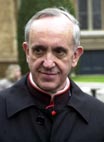
After Cardinal Jorge Mario Bergoglio (pictured) of Argentina was elected Pope Francis I, I found it difficult to locate much first-hand information on this first "American" Pope. Since his Wednesday election, here are some thoughts and references.

THE MEDIA'S POOR REPORTING
In the context of this papal election, the secular media, as is unfortunately often the case when reporting on the Church at all, demonstrated an inability or refusal to view the Church or office of the papacy as a theological rather than political. Even prior to Pope Francis' election, a variety of opiners expressed hope for a Pope whom would reverse Church teaching on contraception, abortion, the male priesthood, or marriage requiring a man and woman.

For example, an NBC staff writer expressed, "Pope Francis will likely keep to Catholic teachings that reject abortion and same-sex marriage, experts said Wednesday." CNN news anchor Suzanne Malveaux said, "Because we know that Benedict was very conservative when it comes to gay rights, when it comes to women being ordained in the church, when it comes to birth control. Many of those things that people are looking to and wondering if the church will, in fact, alter or adjust to the times." Similar statements are not hard to find. Any "expert" whom says the Church is not "likely" to change these teachings is, by the very assertion, not an expert on the Church.

In the minutes following Pope Francis' election, Wikipedia quickly updated the Pope Francis and Cardinal Bergoglio entries with the assertion: "Like most people, he supports the use of contraception to prevent the spread of disease." The footnote link for this claim was inaccessible. The claim itself has since been removed and remains unfounded. This misrepresentation itself was done to Pope Benedict XVI, as covered previously at The Catholic Voyager in What the Pope really said about condoms. On the Kresta in the Afternoon radio show Thursday (MP3), Dr. Janet Smith called such false rumors "wishful thinking."

To state the obvious, it is impossible for a dogmatic teaching on a matter of faith or morals to be "rejected." Sentiments such as these demonstrate a view of the papacy as a political office. Candidates go in and out, bringing to the table or legislatures whichever "laws" are determined. Such rules can be affected by a "vote." But the Church does not operate in this fashion, teaching that such truths are transcendent to manufacturing and are rather identified from reality. Such members of the media do not afford the Church the very views it professes to assert in expressing its teaching on such matters. In other words, in order to understand the Church's teachings, one at a minimum must confront the Church's own basis for those teachings.

Here is an analogy to understand the Catholic teachings on such moral dogmas as are above mentioned. To ask the Church to "reject" one of these views is tantamount to demanding that the Church "adjust to the times" and recognize that three-sided objects should be called "squares." It is, in reality, an impossibility for a square to have three sides. The Church is powerless to change that reality. If you can understand the ignorance required to demand a three-sided object be called a square, then you can understand the ignorance involved in those demanding the Church reject immutable dogma.

At a minimum, even if someone disagrees with the Church's teaching, it would be basic, prudential reporting to notify one's audience that the Church teaches that it is impossible for these teachings to be "rejected." As an apparent strategy, the media sometimes showcases a "Catholic," or perhaps even a priest or religious, whom rejects these teachings to give the impression that the issue remains unsettled in the Church. However, this belies the Church's teaching that dogma is formulated and recognized by the body of the Magisterium, that is, the Pope and bishops in union with him. Dissenters do not effect dogma. The sensibilities of unbelievers do not effect dogma.

ATTRIBUTES OF POPE FRANCIS
Pope Francis brings at least couple "new" attributes to the papacy.
  • First Jesuit
  • First American
Jesuit
Some Catholics are concerned by Pope Francis' status as a Jesuit. This is apparently due to a Jesuit reputation to, perhaps similar to the media, challenge Church dogma. This is not a matter I have studied extensively, but if it is true that some Jesuits have a heterodox bent, this needn't be forced onto Pope Francis as his personal characteristic. After all, Father Mitch Pacwa from EWTN, for example, is a Jesuit and has been an excellent teacher of the faith.

Regarding Pope Francis' Jesuit background are a couple quotes I've come across from respectable Catholic commentators:
An incisive thinker and intensely holy man living a devout life, it is held against him that he is a Jesuit, although he has suffered the slings and arrows of Jesuits of a more "progressive" bent. (The late Fr. Richard John Neuhaus of First Things on Cardinal Bergoglio, 2007)
He was known in Argentina as the Jesuit who lived like a Franciscan. ... He's a very different kind of Jesuit. He's an old school Jesuit. Think of Father James Schall from Argentina and you begin to get the idea. Bergoglio was persecuted by his leftist Jesuit brethren in Argentina.  There were not champagne corks popping around the corner from where I'm sitting right now at the Jesuit Generalate last night, I'm quite sure. (George Weigel, on Kresta in the Afternoon radio show, March 14, 2013 (MP3))
First American and the Eastern connection
Sometimes you might hear that Pope Francis is the first non-European pope, however, there have been three popes from Africa. One of the things that strikes me most about then-Cardinal Bergoglio's position in Argentina is in the first sentence of his Vatican bio: "Cardinal Jorge Mario Bergoglio, S.J., Archbishop of Buenos Aires, Argentina, Ordinary for Eastern-rite faithful in Argentina who lack an Ordinary of their own rite..."

For those of us hoping to reunite with the Eastern Orthodox Church, this attribute may help. It has apparently been some centuries, perhaps over 1000 years since there was an Eastern Rite pope. I have a particular affinity for a number of early saints mutually recognized by both the Catholic and Eastern Orthodox Churches, especially St. John Chrysostom from the fourth and fifth centuries, whom I have cited a number of times on this blog and in forums. There remains a mutual foundation upon which reunion can transpire.

For those whom do not know, the Eastern Orthodox Church and Catholic Churches went into schism, commonly acknowledged to have taken place in the year 1054. Now, there is a difference between Eastern Rite Catholics and Eastern Orthodox Churches, one of which is that the former are in communion with the Bishop of Rome, i.e. the pope. Though Eastern Rite Catholics are in union with the Pope, they practice different forms of the Liturgy and have non-doctrinal differences in discipline or sometimes different spiritual emphases native to different cultures, many of which are viewed as similar to the Eastern Orthodox.

Although the Catholic and Orthodox Churches are in schism, there exists between them a certain familial kinship to the point that many in each Church recognize the validity of each other's priesthood and the ultimate sacrament in each other's churches––the Eucharist.
On each side it is recognized that what Christ has entrusted to his Church--profession of apostolic faith, participation in the same sacrament, above all the one priesthood celebrating the one sacrifice of Christ, the apostolic succession of bishops--cannot be considered the exclusive property of one of our Churches. (Joint International Commission for Theological Dialogue between the Roman Catholic Church and the Orthodox Church, 1993, #13)
To fortify optimism for the reunion of these two great Churches some day, the following news appeared in today's Catholic World Report:
In a historic development, it was announced today that Ecumenical Patriarch of Constantinople, Bartholomew I, will attend Pope Francis’ installation Mass in Rome March 19, the first time such an event as taken place since the Great Schism in 1054. (Catherine Harmon, Ecumenical Patriarch of Constantinople to attend Pope Francis’ installation Mass, Catholic World Report, March 15, 2013)
When something happens for the first time in almost 1000 years, something for which countless generations have prayed, there is cause for attention and hope.


THEN-CARDINAL BERGOGLIO ON THE EUCHARIST
One piece from Cardinal Bergoglio I have read over is a catechesis he preached on the Eucharist in 2008. In that catechesis, Bergoglio emphasized a critical attribute in understanding the Eucharist, and by comparison the Church, and really much of Catholic theology. That attribute is the nuptial nature of Christ's sacrifice. (See a little about this nuptial character in a prior post Christ, the bridegroom.)

The Cardinal states:
In receiving the Eucharist, we are the ones assimilated to Christ. In this manner, through giving Himself over to be eaten as Bread of life, the Lord starts making the Church. He begins transforming within His Body – in a process of mysterious and hidden assimilation as it is completely given over to the process of nourishment – at the same time, whenever this process can count with the free “yes” of the Church, that assents in faith to the Covenant offered by her Spouse, it transforms into His bride.
There is so much theology loaded into that paragraph. All members of the Church are, in a theological sense, the bride. Utilizing what Pope John Paul II called the Theology of the Body, we can recognize in the union of man and woman a figure of Christ and the Church. The Church "receives" life from Christ, so to speak. And the Eucharist is itself an image of assimilation, which we consume, which by the very form of eating communicates the merger of two entities into one. Yet, as Cardinal Bergoglio points out, unlike normal eating where food is broken down into us, with the Eucharist, we are broken down into Christ. In the sacrament, in the union with the divine Son, we, though fallen, are loved by God, and are raised up through His Son, whom condescended to us, and nuptially joined his Church by his ultimate "giving of himself" on the Cross.

The Cardinal continues, relating the matter to Mary, herself a figure of the Church:
Mary, therefore, is a model of the Covenant, between the Lord and His bride the Church, between God and each man. Model of a Covenant that is company of Love, confident and fruitful abandonment and fullness of hope that irradiates joy.
Here, the Cardinal eludes to Mary assenting to the angel Gabriel's prompt to bear the incarnate Christ, when she said, "Behold, I am the handmaid of the Lord; let it be to me according to your word." (Luke 1:38) One of the reasons Mary figures so importantly in Catholic theology is because of her role in divine revelation as figure of the Church. She sets a pattern by which the bride, the Church, is to follow. When she submits to the divine bridegroom, what is begotten? Life. We, as Church, are called to the same response, the same "yes," as Cardinal Bergoglio wrote above, and by that graced assent, life eternal is begotten.

The complementarity of bridegroom and bride itself relates to the dogmas discussed earlier. A marriage only exists if the "ingredients" of man and woman are joined. This is visible in the natural world, that only a male and female union "bears fruit" in the form of life. The Church has recognized also the spiritual reality of these complementary genders, which effect a true marriage. The matter of contraception is pertinent here as well. In the marriage, the marital act is seen as the giving of the self to the other. Jesus demonstrated the bridegroom's part when he extended his arms and literally gave all of himself to his bride. When a contraceptive is introduced, part of the self is withheld, especially one's fertility, and perhaps other factors such as a willingness to sacrifice with the other to raise a child, which itself fosters the objectification of the other (as predicted by Pope Paul VI in Humana Vitae in 1968). In a way, the denial of the necessary ingredients of man and woman in a marriage is an attack on the Eucharist.

In another letter from 2010, Cardinal Bergoglio wrote emphatically to protect the complementary genders necessary for the institution of marriage.

A THOUGHT ON POPE EMERITUS BENEDICT XVI
The future of the Church promises to be, at the very least, fascinating. It has literally been centuries since a retired Pope lived in concert with a current Pope. It must have been an intriguing experience for Pope Emeritus Benedict XVI to experience the election of his own successor, especially in a world of technology where he could, if he did choose to, watch the dramatic events of the past week unfold. Pope Francis has already spoken on the phone with his great predecessor, and still plans to meet with him in the future. Pope Benedict himself welcomed a large community of Anglicans, themselves a "liturgical" Church, even if the Catholic Church does not recognize the validity of their priesthood or Eucharist. Such acts at that by Pope Benedict might that serve as the needed springboard for ecumenism and reunion with the Eastern Orthodox Church. If we do not see reunion in this generation, future generations may look back to Pope Benedict XVI as a catalyst.


Friday, March 1, 2013

3 great quotes about Pope Benedict XVI


Earlier this month, TCV shared 7 great quotes from Pope Benedict XVI. Now that Benedict is Pope-Emeritus Benedict XVI, I thought I'd share a few excellent quotes about the Pope's legacy and character. There is no commentary this time, just some bold added by me that stood out. These are in no particular order.
  1. The Catholic Church is going to lose the greatest papal preacher since Pope Gregory the Great in the sixth century. That's a judgment I am prepared to seriously defend. Benedict XVI is the greatest papal homilist, the greatest preacher, since Gregory the Great. And I wouldn't doubt that 200 years from now, in the Office of Readings and Liturgy of the Hours, there will be selections from the homilies of Benedict XVI as there are selections from the homilies of Gregory the Great or Leo the Great or John Chrysostom...  (George Weigel, February 22, 2013, on the radio show A Closer Look with Sheila Liaugminas (MP3))

  2. One of the great legacies of Benedict XVI which I've not heard people speak about except myself, of course maybe I'm wrong, is the appointment of bishops. ... Under Benedict XVI, we've had quite consistently, across this country anyway, outstanding bishops. ... We've got young bishops and archbishops here. And I think the great legacy of Benedict XVI has been incredibly good appointments of bishops. And why is that important? Because the Pope can't run everything, but bishops run their diocese and especially the seminaries. And so we're seeing, and we'll see in the future, better, stronger seminaries, better stronger young priests. (Fr. Joseph Fessio on Kresta in the Afternoon, Feb. 11, 2013, hour 1 (MP3))

  3. [V]arious encounters left me with very strong impressions about the personality of this remarkable man. One thing is certain: he is definitely not the sort of Prelate who enjoys the limelight. ... Benedict XVI was not a politician. I am personally convinced that he did not want to be elected, and that like Pius X he accepted this glorious burden under the Cross. ... No doubt his name will go down in history as one of the very many great minds that God with which God has blessed his Church from the very beginning. From the moment the future Pope left his beloved Regensburg until Feb. 28, 2013, he accepted a mission which was not of his own choosing. Let me repeat emphatically: He did not like the limelight. He was never tempted by ambition. He did it in obedience, but an act of obedience which was to him, a subtle form of crucifixion. (Dr. Alice von Hildebrand; Thank you, Benedict XVI; appearing at Catholic News Agency; February 26, 2013)

Tuesday, February 19, 2013

First Unseen now available!


My novel First Unseen is now available through the publisher, Tate Publishing. Visit the author website at www.samentile.com for details and ordering information!

The book is kind of a suspense mystery, a little scary here or there, but nothing filthy, and not terribly long for those who like the fast pace. And for all my Catholic friends, since there aren't that many fiction books out there with Catholic themes or even favorably Catholic characters, this will help support that cause too, and foster more books like this to get published for an under-served market!

Monday, February 11, 2013

7 great quotes from Pope Benedict XVI

Today marks a historic time in the history of the Church and the world. A Pope has announced his upcoming resignation, the first time since 1415. Pope Benedict XVI cited health reasons for his stepping down. In light of this, I thought I would share some of the great quotes from him as Pope or during his years prior. In no particular order (and certainly not an exhaustive list!):
1.  [T]he Roman Missal promulgated by St. Pius V and reissued by Bl. John XXIII is to be considered as an extraordinary expression of that same 'Lex orandi,' and must be given due honour for its venerable and ancient usage. (Apostolic Letter "Summorum Pontificum" issued Motu Proprio, July 7, 2007)
This quote is a summary of Pope Benedict's encouragement of the Latin liturgy. As Catholics, we believe in a solidarity and unification with Christian heritage, not amputated from our predecessors, but united to them. The very language and form of the Latin liturgy brings a special unity with that tradition, as well as a piety and alert to divine grandeur in such signs as the priest, together with the people, facing and worshipping God. The recent language translation of the vernacular liturgy seems an echo of that reality when the priest says, "Pray, brethren (brothers and sisters), that my sacrifice and yours may be acceptable to God..."

Many believe the Moto Proprio contributed to the lifting of excommunications of several members of the St. Pius X Society, hopefully bringing them into union with the Church.
2. It is important to recognize dissent for what it is, and not to mistake it for a mature contribution to a balanced and wide-ranging debate. It is the truth revealed through Scripture and Tradition and articulated by the Church’s Magisterium that sets us free. (Pope Benedict XVI, Address to Bishops of England and Wales, February 1, 2010)
This quote catches my attention for a number of reasons. In our modern society, all too often does commercial media and the like attempt to cite someone who claims to be Catholic, as a legitimate voice for the Church, particularly when it comes to matters of truth in faith or morals. There exists an ignorance in the media and those who accept their suggestions. They proceed ignorantly that the Magisterium has an apostolic teaching pedigree linking it to Christ that does not exist among dissidents, or at the very least, they do not make the effort to let the reader know this is what the Church teaches. The secularist could get a vague grasp on this if they compare it to if the media continually paraded scientists who denied any form of evolution as representative of science in general. The media sometimes seems to characterize the Magisterium as versus the people, while ignoring the faithful Catholics who recognize Church teaching. It is of great value that the visible leader of the Church articulated this matter.

Another side-reason I like this quote is because the Pope here points out the source of truth revealed through the twin channels of Scripture and Tradition. The Magisterium only serves to communicate those truths under the guidance of the Spirit. Sometimes, well-meaning Catholics refer to a "3-legged stool" with regard to Church teaching which includes Scripture, Tradition, and the Magisterium. The 3-legged stool refers to the idea that if any leg of the stool is removed, the stool collapses. I tend to shy away from that analogy because it requires care to communicate that the Magisterium is not like the other two, and the analogy may be confusing for that reason. The Magisterium is not a source. It is the recipient. The Pope summarizes this tidily in the above quote.
3. The transforming 'moment' of [Purgatory] cannot be quantified by the measurements of earthly time. It is, indeed, not eternal but a transition, and yet trying to qualify it as of 'short' or 'long' duration on the basis of temporal measurements derived from physics would be naive and unproductive. The 'temporal measure' of this encounter lies in the unsoundable depths of existence, in a passing-over where we are burned ere we are transformed. To measure such Existenzzeit, such an 'existential time,' in terms of the time of this world would be to ignore the specificity of the human spirit in its simultaneous relationship with, and differentation from, the world. ... [Purgatory] is the inwardly necessary process of transformation in which a person becomes capable of Christ, capable of God and thus capable of unity with the whole communion of saints. ... Encounter with the Lord is this transformation. (Cardinal Ratzinger, Eschatology, p. 230-231, 1988)
I may cite this in forums more than any other quote. First, the entire context of the section on Purgatory has profound Scriptural exegesis, with an emphasis on 1 Corinthians 3:10-15. Much of that discussion can be read in the prior post What is Purgatory? I appreciate his emphasis in not trying to obtusely assign some quantum measurement to a reality that is first and foremost theological. Many times have I seen forum-dwellers ask how "long" purgatory lasts, and this quote is always helpful. Additionally, the Pope here focuses on the entire purpose of purification, of purgation, in a single phrase to make a person "capable of Christ." The emphasis is on the holiness of Christ, union with whom no blemish is compatible. He then unites the entire figure of burning from 1 Corinthians to "encounter with the Lord," drawing out theology from the imagery, as if a precious, gold statue were immolated and purged of all the mire clinging to it because of the very radiance of Christ in its presence, transforming it into himself, the unblemished lamb. This exegesis and theology is Ratzinger/Benedict at his best. I can even remember speaking on a forum with an Anglican, whom embraced the idea of purgatory as Ratzinger articulated it similarly in his encyclical Spe Salvi.
4. [T]his Apostolic Constitution provides the general normative structure for regulating the institution and life of Personal Ordinariates for those Anglican faithful who desire to enter into the full communion of the Catholic Church in a corporate manner. (Pope Benedict XVI, Anglicanorum Coetibus, November 1, 2009)
Some 400,000+ Anglicans converted to the Catholic Church thanks to the Pope's above Apostolic Constitution which facilitated the matter. As with the encouragement of the Latin liturgy attracting many traditional Catholics, the Pope reached out to Anglicans whom believed their church had derailed from truth.
5. Again and again it astonishes us that God makes himself a child so that we may love him, so that we may dare to love him, and as a child trustingly lets himself be taken into our arms. It is as if God were saying: I know that my glory frightens you, and that you are trying to assert yourself in the face of my grandeur. So now I am coming to you as a child, so that you can accept me and love me. (Pope Benedict XVI, Christmas Eve Homily, 2012)
This is one of those quotes that bears a certain brilliance in its simplicity, and focuses on a topic native to all of Pope Benedict's works, that is, love. The Pope here points out a sometimes forgotten attribute of God, which he draws from the revelation of the Incarnation itself. God wills to condescend himself beneath man, even though He is ultimately man's master. He willed to subject Himself to man on man's behalf, a people He does not "need," but has created them and suffered for them, that they might ever spend eternity in a never-ending banquet of joy with Him, all for love.
6. Love—caritas—will always prove necessary, even in the most just society. There is no ordering of the State so just that it can eliminate the need for a service of love. Whoever wants to eliminate love is preparing to eliminate man as such. There will always be suffering which cries out for consolation and help. There will always be loneliness. There will always be situations of material need where help in the form of concrete love of neighbour is indispensable. The State which would provide everything, absorbing everything into itself, would ultimately become a mere bureaucracy incapable of guaranteeing the very thing which the suffering person—every person—needs: namely, loving personal concern. We do not need a State which regulates and controls everything, but a State which, in accordance with the principle of subsidiarity, generously acknowledges and supports initiatives arising from the different social forces and combines spontaneity with closeness to those in need. The Church is one of those living forces: she is alive with the love enkindled by the Spirit of Christ. This love does not simply offer people material help, but refreshment and care for their souls, something which often is even more necessary than material support. In the end, the claim that just social structures would make works of charity superfluous masks a materialist conception of man: the mistaken notion that man can live “by bread alone” (Mt 4:4; cf. Dt 8:3)—a conviction that demeans man and ultimately disregards all that is specifically human. (Pope Benedict XVI, Deus Caritatis Est, 28b, 2005)
Speaking of love, here the Pope clarifies the idea that mankind only needs material things when we minister to them. Mother Teresa was a great example of doing both, giving physical care and yet recognizing the need to care for the soul. We also see in the Pope's quote a timely caution with regard to the power of the State, especially in light of the current government attempting to impose certain of its own dogmatic beliefs onto religious entities.
7. The church will become small and will have to start afresh more or less from the beginning. ... As the number of her adherents diminishes...she will lose many of her social privileges. ... But when the trial of this sifting is past, a great power will flow from a more spiritualized and simplified Church. Men in a totally planned world will find themselves unspeakably lonely. If they have completely lost sight of God, they will feel the whole horror of their poverty. Then they will discover the little flock of believers as something wholly new. They will discover it as a hope that is meant for them, an answer for which they have always been searching in secret. (Fr. Joseph Ratzinger, Faith and Future, 1969)
This quote sounds, to the Christian's ears, discouraging at first, that the Church may shrink in size. Yet, over forty years ago, Ratzinger foresaw society's continuing disregard for the Church, up to and including misrepresentation of the papacy (See for example TCV articles on false pope history at Huffpost and misquoted in UK Telegraph). This has certainly come to pass in many regards in many cultural circles. However, he also sees in that trajectory a purer church, stocked with a renewed spiritual zeal in its simplicity. In a sense, it ties into his purgatory quote, that through a process of purging, a purer product emerges from the other side.

Saturday, February 2, 2013

Psychology of a Pedophile

We have seen over the years various responses to the Church's pedophila abuse scandal, which largely broke in the media in 2002. These have included greater scrutiny and openness among bishops and clergy with regards to reporting, stricter sanctions, the implementation of various third party investigations, and even calls from dissenting Church affiliates for married priests or women priests or a shakeup of Church sexual teaching. There are valid responses to these issues, whether they be implementation, rebuttal, or explanation of the truth of Church doctrine on faith and morals (see for example 10 Myths About Priestly Pedophilia from Crisis Magazine or anything by Philip Lawler on the matter (see CatholicCulture or his book The Faithful Departed: The Collapse of Boston's Catholic Culture).

For the purposes of this post, I'd like to draw attention to a dimension of the matter perhaps forgotten, unknown, or ignored.

THE PATTERN
In 2004, the U.S. Department of Education commissioned Professor Charol Shakeshaft, on staff with Hofstra University and Virginia Commonwealth University, conducted a study revealing widespread child sexual abuse statistics among the nation's educators and school staff.  Citing several different researchers, the study states:
As a group, these studies present a wide range of estimates of the percentage of U.S. students subject to sexual misconduct by school staff and vary from 3.7 to 50.3 percent.   Because of its carefully drawn sample and survey methodology, the AAUW [American Association of University Women] report that nearly 9.6 percent of students are targets of educator sexual misconduct sometime during their school career presents the most accurate data available at this time.
Last year, the high profile case of Jerry Sandusky, arrested for sexual molestation, centered around the non-profit he founded––The Second Mile, a charity ministering to at-risk youth.

Also last year, the Boy Scouts of America released 20 years of data regarding sexual abuse occurring within its boundaries. Studies regarding the Girl Scouts are hard to find, although it is, unfortunately, easy to find cases of abuse occurring by Girl Scout leaders in only a few minutes of searching.

A characteristic common to persons in these professions––priests, educators, youth volunteers, scout leaders, or related professions––is their proximity to children in the very line of work.

ADMISSION OF A CONVICTED PEDOPHILE
Not long after the 2002 Church scandal broke, I came across the August 2003 issue of Psychology Today. In that issue is an article called The Mind of a Child Molester (PDF here).


The first-person confession is adapted from the book Conversations With a Pedophile by Amy Hammel-Zabin. The perpetrator, referenced only as the imprisoned "Alan X," describes the temptation toward molesting other boys even when he was very young himself. In his teen years, he eyed a 10 year old neighbor. In order to gain access to the boy, he volunteered to mow the neighbor's lawn and worked his way to baby-sitting. Aware of the disorder, Alan admits:
After high school I joined the military for a couple of years in the hopes I could alter my path away from pedophilia.
Notice when Alan desired to act out his disorder, he worked his way toward the place where he could find a victim. When he tried to avoid his disorder, he went toward a place where he could not access his preferred victims. Soon after, he returned to his deviance and returned from the military. He writes:
One of the first things I did in my efforts to get established was to associate myself with a local church, one that, of course, sponsored a small Boy Scouts troop. Two months after I joined...[t]he elders asked me to take over [as scoutmaster], and I declined. I desperately wanted to once again be in a position where I was surrounded by young boys but I did not want to take that step until I had the entire congregation convinced that I was doing this with extreme reluctance.
Alan proceeded to build trust among victims and subsequently abused them.

One thing pertinent in this account is the perpetrator's deviance was not borne of his association with the church or the Boy Scouts. Rather, his disorder existed prior to joining those organizations. He brought the disorder to the venue in which he could live out his disorder. And he faked various attitudes to give the impression of his sincerity. He pretended to be a legitimate scout master, when in fact, his motive was ill-rooted.

BEING ALERT TO THE PHENOMENON
The ministerial priesthood, education, youth volunteer groups, scouts, and other related groups fit the desired profile for such a disordered pedophile. Thus, those whom criticize such organizations as themselves the cause for the disorder may be well off the mark, such as in the case of Alan X.

This seems to be an extension of the psychological condition of a wish fulfillment, medically defined thusly: "In psychoanalytic theory, the satisfaction of a desire, need, or impulse through a dream or other exercise of the imagination." However, in the case of some deviants, the satisfaction of the disorder goes beyond the imagination, and into reality, as in the above case study.

Several years ago, the Church moved to implement psychological screening for pedophilia in seminaries. The Church, and the other organizations, should at least be aware of how they might be viewed by a potential pedophile, how they might be viewed as utilitarian for a perpetrator's disorder. Being alert to this phenomenon, and working with psychological professionals, could prove beneficial in preventing abuse and helping those with the disorder.

Saturday, January 26, 2013

Does veneration of saints "take away from Christ"?

If you are a Catholic, perhaps you've heard, or if you are a non-Catholic, perhaps you've said something like this forum poster regarding prayer to or veneration of Mary and the saints like this one: "Praying to saints takes away glory from God."

I touched on part of this topic earlier in Praying to Saints: A Visual Aid. I was recently reminded of a passage in Scripture that prompted me to build upon this topic:
And when we had all fallen to the ground, I heard a voice saying to me in the Hebrew language, "Saul, Saul, why do you persecute me? It hurts you to kick against the goads." And I said, "Who are you, Lord?" And the Lord said, "I am Jesus whom you are persecuting." (Acts 26:14-15)
Jesus associates the members of his body with himself. Consider if a critic, using the same reasoning as the opening paragraph above, said, "I am persecuting Christians, not Christ. My focus is not on Christ." But according to Christ himself, that is not accurate, for Christ bears such solidarity with his members, that he told Saul that Saul persecuted him.

The critic may respond that persecution and veneration are not valid comparisons. But if we insist upon that, we end up saying Christ has solidarity with his members when they are persecuted but not when they are honored. That would certainly be a peculiar idea without reason. It is especially unfounded when we consider what Scripture says about the togetherness of the body in good times or bad:
Rejoice with those who rejoice, weep with those who weep. (Romans 12:15)
Jesus also gives at least one other example in Scripture where he associates in the same way with those who are treated both well and poorly.
"And when did we see thee sick or in prison and visit thee?" And the King will answer them, `"Truly, I say to you, as you did it to one of the least of these my brethren, you did it to me." ... Then they also will answer, "Lord, when did we see thee hungry or thirsty or a stranger or naked or sick or in prison, and did not minister to thee?" Then he will answer them, "Truly, I say to you, as you did it not to one of the least of these, you did it not to me." (Matthew 25:39-40, 44-45)
In the above Matthean passage, Christ expresses the ultimate solidarity with the members of his body whether they are persecuted or ministered to. Feeding a hungry member is to feed Christ. Forsaking a hungry member, is to forsake Christ.

Though it is possible to venerate to excess, to even idolize another Christian, proper veneration is a worthwhile cause. For if we justly venerate members of the body, Christ tells us we venerate him.

Saturday, January 5, 2013

Novel "First Unseen" coming soon


For those who don't know, my novel First Unseen is projected for release around February 2013. I've set up an author website at www.samentile.com. Visit the site for more information and to stay abreast of release details!

Sunday, December 30, 2012

3 false mantras intended to silence the Church

In today's entry, I examine 3 mantras or buzz terms extant in today's media and culture, each of which are logically flawed arguments, and each of which are intended to gather support for the censorship of the Church. Sometimes these statements are made by non-Catholics, and sometimes they are made by those who claim to be Catholics in good standing.

#1 - THE CHURCH NEEDS TO CLEAN UP ITS OWN PROBLEMS FIRST!

This type of argument is perhaps most commonly seen in news story comboxes.

Examples:
An ABC News commenter writes: "As soon as the Catholic Church cleans their own moral house – they can tell Catholics and Non-Catholics how to live their lives." A Minnesota Minnpost commenter writes: "Until the Catholic Church can clean up there own sins, [they don't] have any right to talk about any law." In another paraphrased echo, a Nov. 2012 CNN blog responder writes: "The catholic church needs to clean up their own pedophile-filled sewer before they try telling anyone else how to think."
Admittedly, comboxes are havens for high emotion and bombast. But this mantra is extraordinarily prevalent and not exclusive to comboxes. I distinctly remember 670 The Score host Mike North, prior to his departure from the station a few years ago, make the exact same argument in response to some public statement from a member of the clergy.

But all of these comments have the same basic demand. The Church must remain silent as long as sin exists within it. The problems with this argument are multifold.

To begin, these arguments, all recent, are founded on the myth that the Church does not address sins within the Church, particularly with regard to the pedophilia scandal of recent years. The folks over at TheMediaReport.com have cataloged a number of statistics on the improvement in Church self-policing in the last 10 years, in addition to stories often overlooked, such as false accusations that have falsely nourished the myth of universal sex abuse or other scandal in the Church. The Church has also permitted third party investigations, including the vast and recent John Jay report last year. The Church has called for seminary screening to include psychological tests in an effort to prevent infiltrators from abusing the priestly office. Early in the exposure of the scandal, the American Church brought in Kathleen McChesney, a former FBI agent to remedy the situation. The Church's response goes on and on. To argue that the response could be "better" or not is beside the point. Those who argue the Church doesn't address these matters are simply advancing falsehoods.

Secondly, these comments calling for silence are often addressed to priests or bishops who are by all accounts innocent of any scandal. What justice is there for my local priest, innocent of the crimes of a minute percentage of his peers, to suddenly forfeit the entire purpose of his ministry and refuse to teach morality from the pulpit? The demand is nonsensical on its face.

And third, imagine the following analogy. Mr. & Mrs. Smith have two sons. The elder son is caught taking harmful and illegal drugs. The parents have a talk with the elder son. But soon after, he acquires the drugs again, and is involved in an ongoing drug problem. Meanwhile, Mrs. Smith finds out that Mr. Smith has a certain addiction to visiting strip clubs. This has caused an obvious additional rift in their marriage and in the family. Finally, the youngest son decides to become a petty thief. Mr. and Mrs. Smith have a talk with the younger son, explaining to him that it is wrong to steal. The younger son back-talks to his parents, to those in charge of "shepherding" him. He tells his parents they have enough sin to deal with in their household. The parents admit their problems and their ongoing efforts to solve them, but the younger son ignores the concession. He says "until" they "clean up" their sins, he will go on stealing. The younger son demands the parents' voice be silenced.

At the end of the day, where does the younger son fail? Do the parents have problems in their home? Yes. Do they admit the problem? Yes. Are the parents still the parents? Yes. Does the younger son ever confront the idea that stealing is wrong? No. That is where the younger son, the one who attempts to silence those who love him, fails. Stealing is right or wrong independent of the parents' personal problems. The association made by the youngest son is therefore flawed. And regardless of their ongoing issues, loving parents retain every right and obligation to articulate the immorality of thievery.


#2 - THE CHURCH IS ARCHAIC!

Another method to avoid confronting the teachings of the Church is to accuse the Church's positions of being archaic or old-fashioned.

Examples:
Raymond Gravel, an openly dissident Canadian priest, is quoted: "The leaders of the Catholic Church...have locked themselves up in their archaic and obsolete doctrines...they refuse any re-definition of marriage that would allow homosexual couples to legalize their union." Pamela Haag, appearing in the Huffington Post (whose erroneous, anti-papacy material I addressed previously) writes in defense of abortion and modern "sex": "Without access to affordable, reliable, convenient birth control, heterosexual men's and women's sex lives are effectively rolled back to the pre-Griswald 1930s." Following the Pope's recent utilization of Twitter, an anti-Catholic cartoon caricatured the Pope as saying: "This 21st century technology is great for spreading my 15th century views on gays, women and contraception!"
What is perhaps most peculiar about this line of argumentation is the insinuation that if an idea has an older or ancient pedigree, it must be wrong. Again, the accusation is nonsensical on its face. My eyebrow of suspicion is especially raised at the lack of similar accusations against modern scientists who continue to advance Isaac Newton's 17th century views on gravity and physics. Or where are the opponents of the applicability of Shakespeare's 16th century philosophies on love and other realms? Let's not even mention those professors who keep using Pythagoras' archaic 6th century B.C. mathematics!

The main point, of course, is that this "appeal to modernism" (argumentum ad novitatem) logical fallacy fails to confront the substance at hand. Consider abortion. For example, if the Church teaches abortion is wrong because it kills a person in the womb, then attempting to confront that claim by calling it "archaic" neither defeats the Church's position nor supports the arguer's position. It doesn't tell you anything about the validity of the argument. It instead treats it like a style of clothing. It says, "The Church has been pro-life for 2,000 years––you wouldn't want to support that any more than bell-bottoms, right? You'd be out of fashion!"

Secretly, the "archaic" line of argument defeats itself, for its logic defers to a future postulator that calls it old-fashioned.


#3 - THE CHURCH IS "INTOLERANT," "BIGOTED," AND "[INSERT DEROGATORY NAME-CALL HERE]"

Let's cut right to some examples:
Quoted in the UK Telegraph, a dissident group that rejects Church doctrine called the Church "mysoginist," "homophobic," and "intolerant." A gay rights group in England named Cardinal Keith O'Brien "Bigot of the Year," for believing same-sex unions are not "marriages." In May 2012, NY Times opiner Maureen Dowd wrote an article which warned in the headline of "the church's intolerance," and went on to claim that the Church is "intent on loyalty testing, mind control and heresy hunting. Rather than all-embracing, the church hierarchy has become all-constricting."
Let's forget for a moment about the 800-lb gorilla of irony who ghost wrote Ms. Dowd's column, and how her column is a test of the Church's loyalty to Ms. Dowd's views, is an attempt to influence the minds of her readers to her position, is an accusation that the Church has violated Ms. Dowd's defined heresies of "intolerance," and has constricted the Church's option on doctrine to the boundaries Ms. Dowd has set. I don't even know what to make of the "mind control" comment, but I pray I am not writing this with the spiraling eyes of a drone.

But what is the issue here, once again? None of these name-calling monickers confront the Church's actual position. They are strawmen or perhaps, more accurately, non sequiturs. If the Church believes that a sacrament, such as the priesthood, demands terrestrial representation of that which it signifies, and therefore maleness must be characteristic to depict Christ, the incarnate male bridegroom of the Church, then what productivity is there in simply shouting "mysoginists!" as a response? The same would apply to the Church's view of the complimentarity of males and females with regard to marriage, or the Church's view of life, etc...

If one refuses to confront the Church's position on the natural and theological plane and foundation from which it is taught, one can hardly seek refuge in name-calling as an adequate substitute. Instead many of the accusers have set up certain doctrines of their own. And those who do not comply are branded bigots of some sort.


EPILOGUE

There was a time when anti-Church accusers would prop up the Inquisition as one of a handful of historical events when trying to establish mistrust in the Church. Their view of the Inquisition was that the Church forced people to comply with Church doctrines or face quantifiable persecution. Today, that same activity is taking place and now faces the American courts. Catholic or other religious institutions are threatened under penalty of potentially crippling fines to embrace the state's doctrine of the virtue of funding birth control, abortifacients, and other bodily dysfunctioning sterilization procedures. Those who do not comply are branded as bigots, intolerant, archaic, and told to clean their sins before fines or potential arrests to civil disobedience are administered. What is it but a 21st century "Inquisition"? Have the Church's critics gone so far as to become what they have purported to loathe?

In 1942, C.S. Lewis's book The Screwtape Letters was published. It is a fictional tale utilizing theological perspectives. In it we read letters from a master demon counseling his apprentice as to how to lead a certain man assigned to the apprentice to hell. Page 1 contains the following excerpt:
Your man has been accustomed, ever since he was a boy, to have a dozen incompatible philosophies dancing about together inside his head. He doesn't think of doctrines as primarily "true" or "false", but as "academic" or "practical", "outworn" or "contemporary", "conventional" or "ruthless". Jargon, not argument, is your best ally in keeping him from the Church.
And so when you see various false mantras assigned to the Church in an effort to silence Her, remember to ask yourself, what is the Church's actual position? Can I articulate it in a way the Church would recognize as Her own argument? Is dismissing the Church's position as "archaic" or "intolerant" an adequately reasonable or just response?

Saturday, December 1, 2012

Wallpaper: Night Church Silhouette

I recently put together the below desktop wallpaper graphic of a church silhouetted at night. Inspiration for the image came in part from the Catholic Church at Cambridge.


Download your free The Catholic Voyager Night Church Silhouette wallpaper! (Just click the size you prefer below and it will open in a new window. Right click the image and chose "save image as" to download.)


Friday, November 30, 2012

Suffering & Heroic Christianity


For many Christians, events and circumstances of the world try their resolve and the faith to which they have devoted themselves. In such dark hours, or even dark days or years, a weary child of God may find him or herself wondering how circumstances can burden so long or intensely. They might even be bombarded by others who tell such Christians that they are the cause of their own suffering. Perhaps even another Christian preacher who professes a prosperity gospel tells them their trials are due to some sin or deficiency in their very faith. Perhaps these weary Christians pray for the same things over and over and never see an answer in accord with the petition. They feel a type of emptiness or distance from God. And they ask themselves, does not divine revelation speak of Christians having "hearts that burn within" (Luke 24:32) for Christ? Shouldn't that be always? And does not God say "Ask and you shall receive"? (Matt. 21:22) And so the crosses they bear and the distance they feel from divinity become matters of suffering and can challenge their faith.

As difficult as it sometimes may be, such Christians may consider remembering the totality of divine revelation and the wisdom of the saints.

Consider the Biblical book of Job, perhaps the most famous work in human history regarding the matter of suffering. Job is an icon for a righteous person who suffers in spite of his righteousness. He is a precursor to God incarnate, who humbled Himself and accepted unjust suffering at the hands of His own creatures.

Job is stricken with a variety of physical and financial afflictions and the loss of family. Only after a lengthy period of grief is he renewed, his "losses" recovered multifold (Job 42:10) so to speak, with restored health, family, and treasures. The restoration to this "new life" reminds us of the eternal life anticipated by a Christian that supersedes all previous joys in life. It is the "treasure in heaven" that is the prize on which the Christian sets his eye. (Luke 18:22)

The man Christ, just as many of his suffering Christian followers thereafter, cried out to God to be spared the suffering, bloody "cup" which he endured and to which he was headed. (Matt. 26:39) Yet it seems this petition was not answered in accord with how it was stated. From that point, Christ remained in suffering, and was scourged and crucified, the ultimate innocent man, suffering the ultimate penalty. Christ had added a caveat to his prayer, that ultimately, to let God's will be done. And after all his suffering, the Christian witness testifies to his resurrection and glory.

Thus, in these examples of Job and Christ, the Christian may not necessarily know the mechanics of the value of suffering and how it can be converted into great spiritual treasure, or how we are purged by it into holiness. But the Christian can have reason to believe that value exists because of these accounts, especially in regards to Christ. If Christ was God incarnate and accepted suffering in solidarity with man which lead to glorification, then should not the grieved Christian hope for the vanquishment of the darkness?

There is here, perhaps, an inspiring truth for the suffering Christian. Great is the faith of the one who remains faithful even in darkness. Consider the words of saints:
Blessed Angela of Foligno says that the prayer most acceptable to God is that which we force and constrain ourselves to say. Such is the prayer we turn to not for the pleasure found in it or because of our own inclination but purely to please God." (St. Francis de Sales, Introduction to the Devout Life)
As for my outer man, it too, since the spirit does not respond to it, is so besieged that it finds nothing to refresh it on the earth if it follow its human instinct. No comfort is left it save God, who works all this by love and very mercifully in satisfaction of His justice. To perceive this gives my outer man great peace and happiness, but happiness which neither lessens my pain nor weakens the siege. (St. Catherine of Genoa, Treatise on Purgatory, chap. 17)
Great power, says St. Francis, is there in a prayer made with pain. St. Catherine speaks of the siege she endures, and even though she is able to recognize the love of God in her suffering, the pains are no less weakened. These are two venerated saints whose words can inspire those in the midst of such suffering. Even if the pain remains, they can take consolation through it, that great is their prayer from the cross, as is their faith, following in the footsteps of Christ whom first showed the obedient way through suffering.

To maintain hold of the cross, following the Lord through the trial is to exhibit heroic Christianity. It is to be like a docile child, trusting of his parent as he is led through an unpleasant situation he cannot understand even with explanation, yet the parent knows it is for his benefit.

A parable comes to mind, the Parable of the Two Sons (discussed previously at TCV), when reflecting on this image of the heroic Christian who faithful through feelings of darkness.
28"What do you think? A man had two sons; and he went to the first and said, `Son, go and work in the vineyard today.' 29And he answered, `I will not'; but afterward he repented and went. 30And he went to the second and said the same; and he answered, `I go, sir,' but did not go. 31Which of the two did the will of his father?" They said, "The first." Jesus said to them, "Truly, I say to you, the tax collectors and the harlots go into the kingdom of God before you. 32For John came to you in the way of righteousness, and you did not believe him, but the tax collectors and the harlots believed him; and even when you saw it, you did not afterward repent and believe him. (Matthew 21: 28-32)
In this parable, the good son is the one who originally didn't want to do the father's will. Yet in spite of his instinct to resist, he overcomes his lethargy. He overcomes his obstinance. He conquers his lack of desire. It is this son who resembles the heroic Christian. The heroic Christian does not depend on constant feelings of a burning heart to respond to God. The heroic Christian understands that this earthly pilgrimage is not the final order, and that when he "asks" he can expect to receive, if not in this life, then multifold in the eternal life. He knows this because the master he trusts first showed the way, even if the pain persists as he follows.

Thursday, November 1, 2012

Wisdom from the Diary of St. Gemma Galgani

It's All Saints Day today. It seems appropriate to post about a saint. Recently I finished reading the Diary of St. Gemma Galgani. A little background on this saint, thanks to Glenn at stgemmagalgani.com: Born in 1878, she was an Italian mystic, and at the time of her writing, she was 22. She was advised to write this journal at the prompt of her spiritual director. She passed away at age 25. I usually use an ereader now, and below are some of the highlights I made and additional reflections on this modern saint.


[E]yes that have been mortified will see the beauty of Heaven. (p. 10)

St. Gemma recalls numerous encounters she has with apparitions of Christ, saints, and her guardian angel. The previous quotation was told to her by her guardian angel. The eyes are often mentioned in Scripture for both good and bad. Job, feeling the torments of earthly life, cries out:

For I know that my Redeemer lives, and at last he will stand upon the earth; and after my skin has been thus destroyed, then from my flesh I shall see God, whom I shall see on my side, and my eyes shall behold, and not another. (Job 19:25-27)
There is a certain goal for Job to "behold" God. Divine revelation gives another perspective on the "eyes" in the Gospels. For instance, in shocking language, it is written:
And if your eye causes you to sin, pluck it out and throw it away; it is better for you to enter life with one eye than with two eyes to be thrown into the hell of fire. (Matt. 18:9)
And so we are taught by the voice of God through Scripture 2 realities. 1) We must remove our "sinful eye"; and 2) The one who does this, in an ironic twist of sorts, ends up with the ultimate beatific vision in heaven. St. Gemma's angel encapsulates this idea in a tidy sentence.

The days pass and here I am always in the same worldly abyss. (p. 19)

It is not unique to St. Gemma to express grief in a Christian's place in the world. A few years ago, I read St. Padre Pio's letters to his spiritual director, and he often felt terrible weight and pain, particularly when he could not "feel" God's love. As I understand, Bl. Mother Teresa of Calcutta expressed similar sentiments in her letters. Some interpret this skeptically, as a pock mark of sorts against Catholicism or those who walk in the way of the Church. I see it entirely the opposite. I'm reminded of the words of Christ:
For if you love those who love you, what reward have you? Do not even the tax collectors do the same?  (Matt. 5:46)
If we look at these saints, like St. Gemma, feeling the strife of the world in light of Christ's counsel, there is evidence of a phenomenon. These saints retained their faith in Christ even through the darkest hours. There were times when they rejoiced, but they didn't demand the constant feelings of joy in order to keep coming to Christ's table, to keep believing in his promises spoken as the Incarnate Son of God. St. Gemma repeated a paraphrase of this sentiment more than once in the diary. It speaks of a heroism in her resolve against the weight of the worldly pilgrimage. The idea can be inspiring rather than discouraging. Such saints exhibit love for Christ.


Later, she demonstrates exactly the kind of love born of conviction rather than emotion or feelings:

Sunday has arrived. What indifference, what dryness! Still, I do not want to abandon my usual prayers. (p. 24)


This is a similar aspect of love to which married couples are called. They vow to remain faithful "in good times and in bad." Both married and unmarried saints, as members of Christ's bride, the Church, are thus called to love in good times or bad. The inclusion of St. Gemma's heavy sentiments in her diary is rather an inspiration.

That night I suffered a lot because I too wanted to go to heaven, but no one thought to take me. (p. 29)

St. Gemma wrote this after telling of her vision of a Mother Giuseppa who appeared to her and thanked her for praying and offering penance to help Mother Giuseppa attain the heavenly joy. St. Gemma's longing to go to heaven is reminiscent of St. Paul:
I am hard pressed between the two. My desire is to depart and be with Christ, for that is far better. But to remain in the flesh is more necessary on your account. (Phil. 1:23-24)
You see how Paul, too, desires to "depart" and be "with Christ" in heaven. The Christian soul feels a sense of detachment to the world, belonging somewhere "else," so to speak. Yet, Paul, and St. Gemma, stayed true to their devotion, work, and prayers in accord with the call they received. There remains a certain importance in toiling in the world during one's life. As one of my professors noted, this is the time, the opportunity for "merit." Recently, I saw Dr. Peter Kreeft speak, and one of the lines he said that remains with me is, "Grace perfects nature." In Catholic theology, the world is not just some fallen place of evil, even if it is a pilgrimage "on the way" to point B. We remember that Christ came incarnate to the world. Mary, giving birth to personified grace himself, delivers grace into the terrestrial realm. As dwellers of this place, we can receive that grace made possible through his solidarity with mankind. Elsewhere St. Gemma wrote:

I find a little peace only in that bit of suffering Jesus sends me, offering it first for sinners, and in particular for me, and then for the souls in Purgatory (p. 23)

As members of "Christ's body, the Church" (eg. Eph. 1:22-23, Col. 1:24), we suffer in union with him. It is because we are "sharing" Christ's suffering that there is merit and power to our toil. You see in the second-to-last quote how St. Gemma, though she had an inward desire to depart this world and go to heaven, plods in this world for the sake of her soul and for others. This is another example of love working through this saint.

[H]e brought me a cup of coffee... (p. 31)

These words, St. Gemma spoke regarding her guardian angel. It got me thinking that I would not complain if my guardian angel did some chores for me, perhaps starting with laundry.

Whoever reads these things, I repeat again, should not believe, because they are all my imagination... (p. 43)

This, St. Gemma wrote after describing an encounter with the Virgin Mary in which the Blessed Mother cradled her. Read in isolation, the statement sounds like an admission that her mystic experiences are an illusion. But such is not the case in the context of the diary, or even the remainder of the sentence which says:

Whoever reads these things, I repeat again, should not believe, because they are all my imagination; nevertheless I agree to describe everything because I am bound by obedience, otherwise I would do differently.

St. Gemma expressed displeasure in her diary at having to write it. But what is revealed here is that her spiritual directors recognized something in her that they wished to preserve. Other times revealed that her visions went beyond something mental, such as when she wrote of attacks by the devil. On one occasion, she wrote that the

devil gave me such a strong shove that I fell off the bed, causing me to bang my head on the floor with such great force that I felt a sharp pain; I fainted and remained on the ground for a long time before regaining consciousness." (p. 31)

Additionally, she would sometimes speak that her "head would take off." I read this book in English, so I am not certain what the original Italian may have said, but she used this phrase in the context of having a vision. So when she wrote that one should not believe her story about the Virgin Mary holding her, she seems to refer to it occurring in her "imagination" as opposed to in some physical encounter. As well, she distinguishes at other times incidents where her "head would take off" with other visions:

When my guardian angel comes, I am awake, and my head does not take off; Jesus, my Mom and sometimes Brother Gabriel make my head take off; but I always stay where I am; I always find myself in the same place, it's just that my head departs. (p. 13)

It is statement such as these that shed light on her description of the Marian vision occurring in her "imagination."

Finally, I wanted to point out two other occasions in which St. Gemma's name has recently come across my path.

The first is in the previous "saint" book I read, Padre Pio: Under Investigation. The book re-prints an April 7, 1913 letter from Padre Pio to Fr. Agostino. After the letter, the author, Castelli, notes that this letter from Padre Pio was "one accused of being the product of plagiarism because of the consonance, of language and theme, with a private apparition to Saint Gemma Galgani." (e-location 875) The author produces the case, however, that Padre Pio's letter was authentic, not plagiarized, and that his experience was only similar to St. Gemma's. It is interesting to note once again, the similarity in the experiences of some saints, not only with suffering, but here with the character of an apparition and inspiration of words.

The second is from another book I reviewed, The Rite. The book opens with a vivid description of an exorcism and the dialogue exchanged between the demon and the priest. During the ordeal, the priest determines that the demon is writhing against the presence of some unseen saints in the room, and at times fought against these unseen figures at which it screamed. One was Mother Teresa of Calcutta. One was Bl. John Paul II. And the other was St. Gemma Galgani. The author, Baglio, determined from the possessed victim, that St. Gemma "was dressed in her traditional black, and looked very much as she had in her twenties." (p. 2)

It is what the saints do. They serve as members of Christ's body, members that do spiritual battle on behalf of the Church. All the more sense does Paul's analogy of the Church's "body" with parts of a human body having parts that work together. (cf. 1 Cor. 12) And some saints, it seems, are called to be part of the fighting hands of Christ's body.

Saturday, October 27, 2012

Update on Indiana vs. Planned Parenthood

Following is an update to the 2011 story involving the state of Indiana's attempt to withhold Medicaid funding to Planned Parenthood (PP) of Indiana. PP argues that Indiana cannot exclude it from federal Medicaid funds.

Since that time, a district judge blocked the state's attempt to withhold those funds. This past Tuesday, October 23, a ruling by the 7th U.S. Circuit Court of Appeals in Chicago supported that decision and argued that Indiana must give Medicaid dollars to PP.

The circuit court's opinion can be read here (PDF). The circuit court judges were Diane Sykes (who wrote the opinion), Richard Cudahy, and Michael Kanne. 

THE 7TH CIRCUIT COURT'S SPECIFIES THE CRITERIA FOR A PROVIDER TO RECEIVE MEDICAID FUNDS
The opinion explains the matter thusly:
Under § 1396a(a)(23) state Medicaid plans “must” allow beneficiaries to obtain medical care from “any institution, agency, . . . or person, qualified to perform the service.” This is individual-rights language, stated in mandatory terms, and interpreting the right does not strain judicial competence.
That means anyone qualified to perform a medical service covered by Medicaid must receive federal  Medicaid funds, according to the circuit court's opinion.

Gavel2 

INDIANA'S EXAMPLES SHOWING THE COURT'S CRITERIA IS NOT DECISIVE
However, the court's own analysis of the case may not adhere to that criteria. First, let's look at the rationale for why PP is considered a "qualified" provider, as well as the definition of "qualified" the court claims to be following (emphasis mine):
Although Indiana has broad authority to exclude unqualified providers from its Medicaid program, the State does not have plenary authority to exclude a class of providers for any reason—more particularly, for a reason unrelated to provider qualifications. In this context, “qualified” means fit to provide the necessary medical services—that is, capable of performing the needed medical services in a professionally competent, safe, legal, and ethical manner. The defunding law excludes Planned Parenthood from Medicaid for a reason unrelated to its fitness to provide medical services, violatingits patients’ statutory right to obtain medical care from the qualified provider of their choice.
We now read ahead to the court's dismissal, for example, of two of Indiana's arguments from precedent that they can view PP as an unqualified provider. Here is the first, retold in the the circuit court opinion (emphasis mine):
Indiana also points to 42 U.S.C. § 1320a-7(b)(14), which allows states to exclude providers who are in default on their student-loan payments, and from this provision makes another argument by implication: If the states may refuse to subsidize student-loan delinquents with Medicaid dollars, then they must have the authority to “avoid indirect financing” of any “non-Medicaid” conduct. But like § 1396a(p)(1), this statute merely stipulates a particular ground for excluding a Medicaid provider; it does not imply that the states may establish any rule of exclusion and declare it a provider “qualification” for purposes of § 1396a(a)(23). That would make the free-choice-of-provider requirement a nullity.
And the second (emphasis mine):
Nor does Guzman v. Shewry, 552 F.3d 941 (9th Cir. 2009), help Indiana’s case. There, a provider was suspended from California’s Medicaid program based on a pending criminal investigation. He claimed that federal law occupies the entire field of regulation pertaining to Medicaid and therefore preempted the state’s disciplinary measure. The Ninth Circuit rejected this argument, relying in part on 42 U.S.C. § 1320a-7(b)(5), which provides that the states may suspend or exclude providers from participating in Medicaid “for reasons bearing on the individual’s or entity’s professional competence, professional performance, or financial integrity.” The court remarked that this provision presupposes state regulatory authority over provider qualifications. Guzman, 552 F.3d at 949. 
Here we have two examples of precedent provided by Indiana's attorneys. Both were examples of Medicaid funds legally being withheld from an entity apart from that entity's competence to perform medical services. Remember, the 7th Circuit Court on Tuesday insisted:
“qualified” means fit to provide the necessary medical services—that is, capable of performing the needed medical services in a professionally competent, safe, legal, and ethical manner. 
Both examples presented by Indiana demonstrate that competency to perform a particular medical service can be trumped by factors unrelated to those medical services. I did not see the 7th Circuit Court address that aspect of Indiana's argument. And yet, in its opinion, the 7th Circuit Court specifically ruled against Indiana because it supposedly disqualified PP for reasons other than it's ability to perform certain medical services:
The [State of Indiana's] defunding law excludes Planned Parenthood from Medicaid for a reason unrelated to its fitness to provide medical services, violating its patients’ statutory right to obtain medical care from the qualified provider of their choice.
The 7th Circuit Court's opinion here is worded such that there are no reasons to withhold Medicaid funding from any entity capable of performing certain medical services. Yet, Indiana's lawyers produced several examples (such as the 2 described above) that demonstrate that is not ultimately the decisive factor. A doctor behind on student loans can still legitimately perform medical services. In the example in which there was a criminal investigation on the provider, the 7th Circuit Court considered it okay to suspend their Medicaid dollars even though there was no guilt at the time the funds were withheld. As well, one of the reasons the 7th Circuit Court supported that opinion is because of the question of the "financial integrity" of a provider. We'll take another look at that aspect of PP's financial statements in a moment.

More from the 7th Circuit opinion:
It is true that Medicaid regulations permit the states to establish “reasonable standards relating to the qualifications of providers.”  42 C.F.R. § 431.51(c)(2). But Indiana claims plenary authority to exclude Medicaid providers for any reason, as long as it furthers a legitimate state interest—here, the State’s interest in avoiding indirect subsidization of abortion. This sweeping claim conflicts with the unambiguous language of § 1396a(a)(23) and finds no support in related Medicaid statutes and regulations. 
The opinion went on from that paragraph to reiterate that "qualified" means competent to perform the medical services in question. The opinion reiterates that standard over and over. In other words, the state can establish "reasonable standards" relating to what is a "qualified" provider––the 7th Circuit Court insists Indiana's criteria is unreasonable on the grounds that PP is able to perform certain procedures covered by Medicaid. Yet the court was willing to suspend that standard altogether as we saw in the examples of the cases on student loans or a pending investigation, as well as other cases presented by Indiana to the courts.

SO DOES PLANNED PARENTHOOD USE MEDICAID DOLLARS FOR ABORTIONS?

Recall from The Catholic Voyager's previous coverage on this case, the state of Indiana submitted to the district court the following argument that PP has not demonstrated that it separates Medicaid funds from abortion services:
PPIN’s audited financial statements for 2009 and 2010 give rise to a reasonable inference that it commingles Medicaid reimbursements with other revenues it receives. ... financial statements provide no record that PPIN [Planned Parenthood of Indiana] makes any effort either to segregate Medicaid reimbursements from other unrestricted revenue sources or to allocate the costs of its various lines of business, whether abortion, family planning, cancer screenings, or other services. ... Medicaid, as a revenue line, is shown with other unrestricted sources of income ... This indicates that, while PPIN may not receive Medicaid reimbursements related directly to abortions (as federal and state laws generally prohibit), the Medicaid reimbursements it does receive for other services are pooled or commingled with other monies it receives and thus help pay for total operational costs.
In other words, PP uses Medicaid funds to pay for total operational costs, which of course includes abortion services not covered by Medicaid dollars. The only comment on this matter I saw from the 7th Circuit Court opinion reads as follows:
Planned Parenthood also performs abortions. The organization uses private funding to support its abortion services and takes steps to ensure that public and private funds are not commingled.
That's it. There is no substantiation that PP prevents Medicaid dollars from going to abortion services other than a cursory statement that it does so. The claim begs the question. The circuit court's opinion is filled with supporting documentation and analysis except on this point. What of the PP's audited financial statements as described by the state of Indiana during the district hearing?

It may be telling, however, that the circuit court's opinion elsewhere implies that Medicaid dollars do indirectly pay for PP's abortion services. Recall this earlier quote: 
But Indiana claims plenary authority to exclude Medicaid providers for any reason, as long as it furthers a legitimate state interest—here, the State’s interest in avoiding indirect subsidization of abortion.
The circuit court's opinion describes the matter, in their own words, as Indiana avoiding "indirect subsidization of abortion." The court's opinion is not qualifying the statement as Indiana's "perception" only, but rather describing the situation as it exists.

So on the one hand, the court dismissively claimed PP separates use public funds from abortion services, and on the other, indicates that PP uses public funds indirectly to subsidize abortion.

Elsewhere, the 7th Circuit Court's opinion suggests the same thing:
The point [of defunding PP] is to eliminate the indirect subsidization of abortion....Act 1210 aims to prevent the indirect subsidization of abortion...
In rebutting this argument, the court does not challenge Indiana's assertion that PP is using public funds to subsidize abortion. It rather seems to admit the claim as fact. Instead, the court insists repeatedly that PP must be funded simply because it is capable of performing other covered medical services.

After reading through the opinion, I was thus left vexed. It seemed that Indiana's strongest argument against funding PP was dismissed with no rebuttal, with no detailed explanation. Instead, the peripheral criteria of PP's "capability" to perform other funds appeared to be inconsistently described as the basis by which a provider must receive Medicaid funds.